

An Oxford Visit: Where Classical Scholarship Meets Digital Technology
We visited Professor Jonathan Prag at Merton College, Oxford, to discuss I.Sicily, his digital corpus of Sicilian inscriptions, its possible connections with Humanitext, and how digital methods and AI are received within classical scholarship — with visits to Keble College and the new humanities centre.

On June 22, 2026, I visited Oxford with Ikko Tanaka and Jun Ogawa.
The main purpose of our trip to the UK was an international conference in London, but there was a researcher I very much wanted to call on while we were in the country: Professor Jonathan Prag of Merton College.
Professor Prag specialises in the history and epigraphy of ancient Sicily, and has spent many years building I.Sicily, a digital corpus of Sicilian inscriptions. It now holds over 3,000 inscriptions, not only in Greek and Latin but in Phoenician-Punic, Oscan, and other languages, all encoded in EpiDoc TEI/XML. It is one of the major projects in digital epigraphy.
Humanitext likewise works with large-scale textual data for Western classics, and Ogawa, who joined the visit, conducts digital research on inscriptions. There were, in other words, clear and specific points of contact with our own work.
Lunch at Merton
Professor Prag kindly had us to lunch at Merton College.
Eating in an Oxford college is familiar territory for me, but returning after some years I was struck again by what a good arrangement it is: an outside researcher can be invited fairly casually, and the research conversation simply unfolds over the meal. This time it was just us, but at an ordinary lunch one naturally ends up beside fellows from entirely different disciplines of the same college.
When we speak of research exchange, we tend to imagine something organised — a joint project, a seminar series. But before any of that comes the everyday layer: inviting someone to lunch to hear what they are thinking, or talking with whoever happens to sit next to you. Oxford colleges make room for such encounters as a matter of course.
That said, Oxford was in the middle of a heatwave. The hall had no air conditioning, and all four of us were soon sweating over lunch. The first topic of conversation was, unavoidably, the heat.
From there, the conversation moved to the question of how digital technology and AI can be introduced into classical scholarship.
Digital methods in classical scholarship
What stayed with me from the conversation was this: even in Britain, digital research methods have not become part of the mainstream of classical scholarship.
There are, of course, important digital classics projects in the UK, including at Oxford. But their existence does not mean that most classicists routinely incorporate data processing or computational methods into their research.
With AI, all the more so.
There is understandable scepticism about the accuracy of AI translation and text generation, and there are also more principled reservations about introducing such technology into classical scholarship at all. The same range of attitudes, it seems, exists outside Japan as well.
At the same time, Professor Prag himself uses AI in a thoroughly practical way. In epigraphy he has been involved in machine-learning approaches to restoring damaged and missing text, and he now incorporates AI coding agents into his daily research work as well.
What interested me was that rather than pronouncing on AI in grand terms, he simply uses it wherever it is good for the job at hand.
When people discuss bringing AI into classics, the question tends to inflate into something like “Can AI read the classics?” In practice, the change is starting in the ordinary stages of research: cleaning data, writing code, working through large bodies of material.
This chimed closely with my own experience of building Humanitext.
Inscriptions and Humanitext
The most tangible scholarly outcome of the visit was the opportunity to hear about the I.Sicily data in detail.
Humanitext has so far concentrated on the transmitted literary corpus — Plato, Aristotle, Homer, and the rest. But since our subject is the classical world itself, inscriptions are by no means unrelated material.
Given that an epigraphic corpus on the scale of I.Sicily already exists, might such material eventually be connected, in some form, to Humanitext’s search and dialogue environment? The conversation allowed us to think about that possibility in more concrete terms.
Adding inscriptions would change what the system could do.
Look up a term or an institution as used in literature or philosophy, and compare it with contemporary epigraphic evidence. Explore a particular city or person across historiography and inscriptions at once. These are uses a corpus of transmitted texts alone cannot quite support.
Of course, inscriptions come with lacunae and restorations, and findspot, date, material, and editorial judgement all matter — they cannot be handled as if one were simply adding more transmitted texts. That is precisely why I.Sicily structures its data so carefully in EpiDoc.
Ogawa, who was with us, works on digital approaches to epigraphic material as well, leaving several promising connections to explore.
No concrete joint project has been decided. But we came away with a clearer sense of how previously separate lines of work might be connected — and that was the great gain of the Merton visit.
Keble in the afternoon
In the afternoon, Tomoki Ishikawa — a specialist on Augustine, currently studying at Oxford — showed us around his college, Keble.
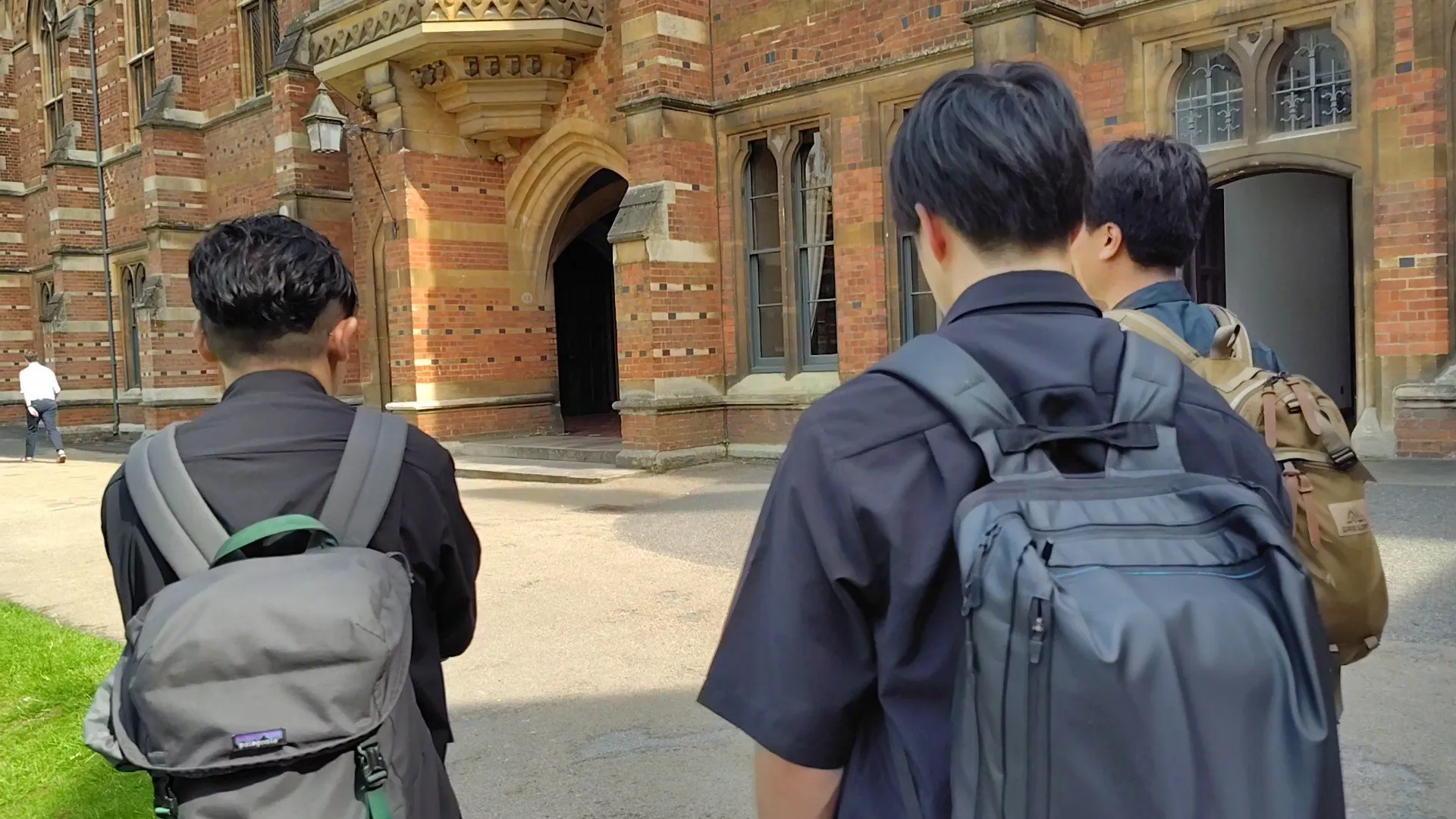
I lived in Oxford for a long time, but I knew almost nothing about Keble. There is a particular pleasure in being shown an unfamiliar college by a researcher who actually lives there and knows its daily rhythms.
Keble was founded in 1870 in memory of John Keble, one of the central figures of the Oxford Movement. From the outset it was conceived to admit students at a lower cost than the established colleges, and William Butterfield’s polychrome brick architecture gives it a look quite unlike the older foundations.
The dining hall in particular is a sight. The present hall opened in 1878 and is among the largest in Oxford. The basic arrangements — high table included — were familiar, but the running of formal dinners and the texture of college life differ from one college to another. As we walked, Ishikawa filled in the particulars.
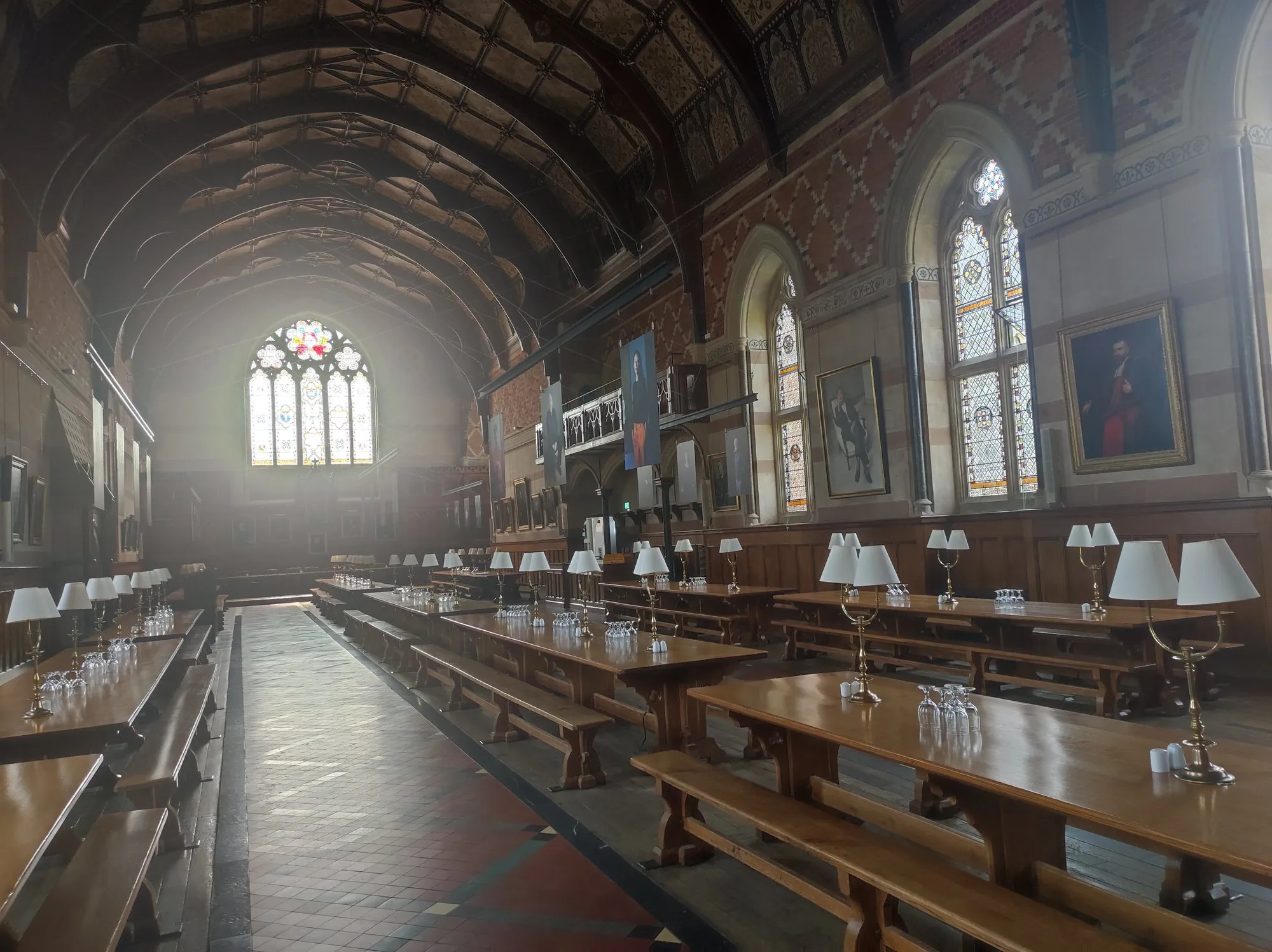
Here too, what I found myself thinking about was the college as an institution.
At Oxford, the college exists alongside — not within — one’s faculty and field, so daily life brings you into contact with people whose subjects have nothing to do with yours. If one’s working life is organised entirely around a department or laboratory, conversations inevitably centre on one’s own discipline; in a college they do not.
Ishikawa also told us about ordinary research life — including the patristics seminar whose participants head to the pub afterwards.
Spend long enough in such an environment and it comes to seem unremarkable. Returning as a visitor after years away, one thinks again about the value of belonging not only to a scholarly field, but also to a community in which encounters across disciplines are part of daily life.
In the morning, visitors like us were folded naturally into lunch at Merton; in the afternoon, we heard what it is like for researchers in quite different fields to share a college at Keble. This may sit a little apart from research itself, but as a set of conditions under which new scholarly combinations can arise, the system works remarkably well.
The new humanities centre
Finally, Ishikawa showed us the new Stephen A. Schwarzman Centre for the Humanities.
It is a large complex that gathers the humanities faculties and research institutes, a library, and teaching and research spaces together with a concert hall and theatre in a single building. Oxford’s image is dominated by its historic colleges, but substantial investment is also going into new research environments for the humanities.
After walking through thirteenth-century Merton and nineteenth-century Keble, it was interesting to end at a facility this new.
And for us, on that particular day, it was above all a place with air conditioning.
Within classics
The most important part of this visit was meeting Professor Prag in person and being able to talk in concrete terms about how digital technology and AI can be taken up within classical scholarship. We also learned that Japan and Britain face difficulties that are unexpectedly alike.
At the same time, the epigraphic data accumulated over many years in projects such as I.Sicily may offer several points of contact with Humanitext and Ogawa’s work in the future.
We came home with several conversations that could lead somewhere. That, in the end, is what the visit yielded — and it is enough.
Related articles
DH2026: AI Translation and the Work of Building Research Infrastructure
Notes from DH2026 in Daejeon: presenting and fielding questions in Japanese with the aid of real-time AI translation, and reflecting on the distance between novelty in research and the less visible work of building infrastructure that scholars actually use.

The God Who Makes Men Forget, the Man Who Will Not: The Ending of the Odyssey
For anyone left unsettled by the ending of the film The Odyssey. The original goes on after the suitors are killed, and it closes with a god making the people forget so that peace can follow. How did the film change that ending? Two endings, on forgetting and memory, read side by side from the lines of the poem (the film's ending is discussed).

Athena in the Odyssey: How Do Homer and the Film Differ?
Why does the film's Athena neither save the hero nor blame him? Set her beside the goddess of the original, who shares her cunning with Odysseus and intervenes at every turn of his homecoming, and the film's design comes into focus.
We Went to See The Odyssey
Four of us from Humanitext saw Christopher Nolan's The Odyssey at an advance screening. Over lunch the talk turned to the armored giants, the Sirens' song, and the journey after the homecoming. Here is what the original says about each, without spoilers.