

DH2026: AI Translation and the Work of Building Research Infrastructure
Notes from DH2026 in Daejeon: presenting and fielding questions in Japanese with the aid of real-time AI translation, and reflecting on the distance between novelty in research and the less visible work of building infrastructure that scholars actually use.

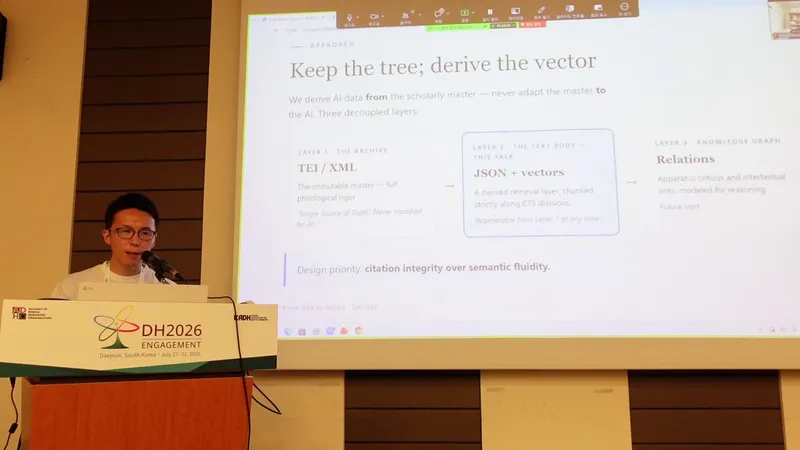
Friday morning, July 31. At the convention center in Daejeon, South Korea, I began my talk in Japanese. It was the first time I had ever presented in Japanese at an international conference.
DH2026, the field’s annual international conference, offered real-time AI translation across much of its programme: in 89 of its 111 sessions, the audio of each talk was translated, and audience members could follow along in another language on their own devices. A conference that takes AI as one of its objects of study had itself been made multilingual by AI. That fact alone seemed to me one of the defining features of this year’s meeting.
I spent some nine years as a researcher in the UK, and at international conferences I have always used English as a matter of course. Precisely because of that background, presenting and answering questions in Japanese gave me an occasion to think again about the relationship between language and international scholarly exchange.
At a conference on “Engagement”
DH2026 is the annual conference of the Alliance of Digital Humanities Organizations (ADHO). Hosted this year by the Korean Association for Digital Humanities, it ran from July 27 to 31 under the theme “Engagement.” It was a large meeting, with 421 papers and 94 posters across 111 sessions.
The Humanitext project contributed three presentations.
On Wednesday, Ikko Tanaka reported on an analysis of actual query logs from Humanitext Aozora, examining how users engage with literary works in an archive built around an LLM. An archive that one searches to locate materials and an archive that one can question in natural language invite somewhat different modes of use; the study traced that difference through real usage data.
On Friday I presented a study titled “From Tree to Vector,” on the problem of connecting the hierarchical structure of humanities sources encoded in TEI/XML with the vector-based retrieval that RAG (retrieval-augmented generation) relies on.
The work is decidedly practical, closer to implementation than theory.
Classical scholarship has citation systems established over a long history: Stephanus pages such as “43a” for Plato, Bekker pages for Aristotle, and book and line numbers for Homer. They allow scholars to point to roughly the same passage even across different editions and translations.
But when you split texts mechanically into fixed numbers of words or tokens for RAG, these units break easily. In Humanitext, we therefore preserve the existing citation units as far as possible — merging sections that are too short, dividing those that are too long — and give every chunk an identifier grounded in the citation scheme.
Taken individually, none of these steps is spectacular. But whether a retrieved passage can be traced precisely back to its place in the original matters a great deal for scholarly use. It bears not only on retrieval accuracy but on whether an answer can be verified after the fact.
In RAG, attention tends to fall on how well the system retrieves appropriate passages. For humanities sources, I would argue that a second question matters just as much: whether what has been retrieved can be returned to the established scholarly system of reference.
Answering English questions in Japanese
In the Q&A after my talk, the questions came in English. I answered them in Japanese.
I understand questions asked in English, and I can answer in English. But a Q&A is a different situation from a prepared script: you must work out the intent of the question on the spot, sort out your own position, and answer with qualifications where they are needed.
The difference that using one’s mother tongue makes in that moment was larger than I had expected.
What struck me most was not simply that it was easier not to have to speak English. Answering in Japanese, I could carry over distinctions and nuances that would ordinarily get slightly flattened in the process of converting my thoughts into English.
The translation, at least in my experience, was genuinely usable. In some cases, composing my answer fully in Japanese and letting the AI translate it may well have conveyed my meaning more precisely than assembling an answer in English on the spot would have.
Of course, translations involving technical terms and proper names need careful checking, and there is no guarantee that the system works equally well in every field. Still, the long-standing assumption that taking part in an international conference requires presenters to speak English is, at least technically, becoming negotiable.
That English is the shared language of international scholarly exchange will not change soon. But using a shared language and everyone speaking the same language are not necessarily the same thing. This experience suggested we are entering a stage where the two can be thought about separately.
A poster with student collaborators
Our other contribution was a poster, “Visualizing Classical Narratives via RAG-Enhanced AI and Iterative Video Synthesis.”
It examines a method for turning classical narratives into film with generative AI while checking sources through RAG, developed through the production of the video work ANIMA ANTIQUA. The co-authors include Chieka Saito and Yuki Suzuki, graduate students at Nagoya University.
The question was not simply whether AI can visualise the classics.
Generative video introduces many kinds of error. Figures or objects absent from the source text may appear; clothing or architecture inappropriate to the period may be generated. At the same time, what counts as an “error” is not always straightforward: where the text is silent, some degree of interpretation is unavoidable.
So we worked out a scheme that iterates between generation and evaluation, sorting out which problems can be detected mechanically and where expert judgement has to take over.
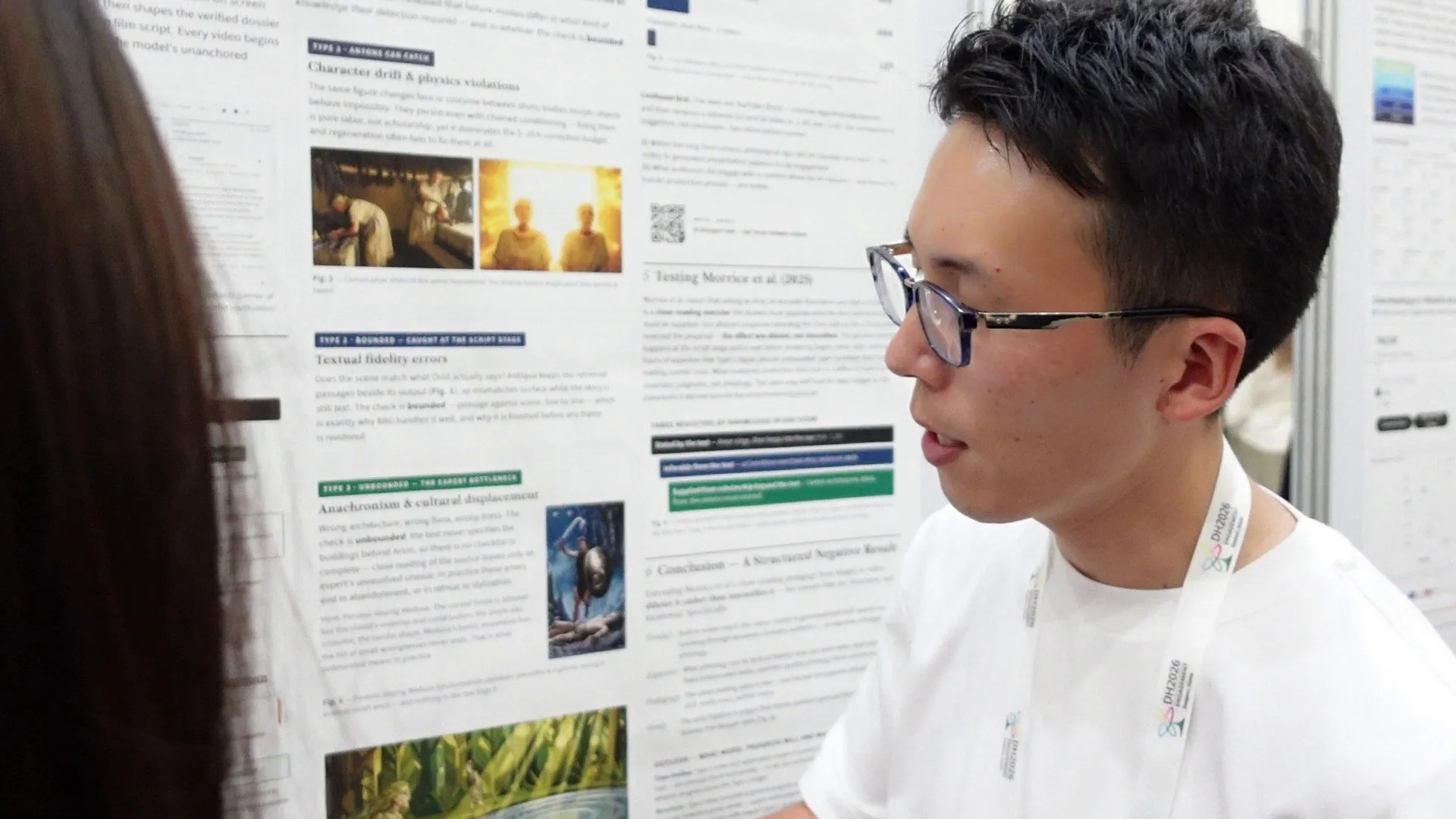
The poster session allowed us to discuss this point in some detail. A talk has to cover a whole project in limited time; at a poster, one can linger over a single question. Many researchers using generative AI in humanities work are concerned with what to automate and what to leave to human judgement, and we received several genuinely useful comments.
Being able to discuss work carried out together with students in a venue like this was, in itself, one of the real gains of the trip.
What I thought about in Daejeon
Reflecting the Asian venue, research on Korean, Japanese, and Chinese materials was prominent: Buddhist texts in classical Chinese, TEI markup of the Nihon Shoki, computational analysis of Tang poetry, and much else. By contrast, presentations squarely on Western classics seemed surprisingly few for a meeting of this size.
Of course, there is much to learn even where the materials differ.
In what units should a text be handled? How should complex structures be described? How should established reference systems be made legible to a machine? How can the results of retrieval and generation be made verifiable? There is no shortage of methodological problems that cross the boundaries between subjects, and I took away a good deal from sessions outside my own field.
But walking the halls, I found myself thinking about a somewhat different problem.
DH research, naturally, demands novelty of some kind. A new analytical method, a new model, a newly designed data structure, an improvement in accuracy over prior work. If you are presenting research, you must be able to say what is new.
As research, that is entirely proper.
Yet when your work is to build digital environments for a particular field of study, you begin to notice a considerable gap between novelty as research and the making of infrastructure that is actually useful.
Humanitext Reader is a clear example.
In bare technical terms, it is a service that translates ancient Greek and Latin with generative AI and publishes the translations alongside the originals. We did not develop a new translation model, nor invent a wholly new algorithm. If someone said, “You are just translating with existing AI,” in a sense they would be right.
But try to make it a bilingual reading environment that scholars and learners can actually use, and a great deal of work turns out to live inside that “just.”
How should we handle stray strings mixed into the source data? How should we accommodate structures that differ from edition to edition? How literal a translation is useful to a learner of the classical languages — and, conversely, how natural should the target language be allowed to become? What instructions will keep a model at that balance consistently? In what units should long works be processed? How do we keep original and translation from drifting out of alignment partway through? How should we standardise the rendering of proper names and technical terms?
None of these, on its own, would be called a new research method.
And yet unless each of these details is adjusted one by one, the result never becomes usable. There is a considerable gap between connecting a model to an API and producing a single translation, and continuously processing hundreds or thousands of works for a reading environment of consistent quality.
And after release, work of another kind begins.
Adding materials. Correcting errors. Acting on feedback from users. Improving the display. Keeping the service up under load. And letting the people you built the tool for know that it exists at all.
This work differs in character from building a research prototype.
What makes it awkward is that much of it does not map well onto the current mechanisms of academic evaluation.
Propose a new method and you can write a paper. But repeatedly tuning existing techniques into a stable pipeline, patiently correcting data, improving an interface, and spending time on explanation and outreach to reach more users — none of that converts directly into publications.
Even so, if you want digital methods to genuinely take root in a field, this part cannot be bypassed.
On reflection, this is not a problem peculiar to digital humanities. Scholarship has always rested on infrastructure: dictionaries, corpora, databases, critical editions, research software. The better the infrastructure, the less its users notice it. The right information appears when needed, and the system runs reliably. That is all the user sees. Maintaining that apparent simplicity, however, takes substantial labour.
Research that produces new techniques and the work of making existing techniques genuinely usable within a particular field overlap — but they are not the same.
When I started Humanitext, I was strongly oriented toward the former. How to apply RAG to classical scholarship, how to build in the citation systems, how to integrate the ancient commentaries. These were also tractable as research problems.
But as the project has grown, the time I spend on the latter has increased.
One could regard that as work peripheral to research proper. I am not sure that is right. If a genuinely useful digital environment for a field does not yet exist, then building it, maintaining it, and bringing it into actual use has a claim to being part of digital research in the humanities.
That said, I do not think the answer is to swing entirely that way. Stop the technical research, and Humanitext itself will eventually go stale. Keep trying new methods one after another, and you merely multiply half-finished prototypes that serve no one.
Continuing to do new research, and cultivating what we have already built into research infrastructure. How should limited time be divided between the two?
At DH2026, stimulated as I was by a great deal of new work, it was this that I found myself thinking about.
I do not yet have a clear answer.
Related articles
An Oxford Visit: Where Classical Scholarship Meets Digital Technology
We visited Professor Jonathan Prag at Merton College, Oxford, to discuss I.Sicily, his digital corpus of Sicilian inscriptions, its possible connections with Humanitext, and how digital methods and AI are received within classical scholarship — with visits to Keble College and the new humanities centre.

The God Who Makes Men Forget, the Man Who Will Not: The Ending of the Odyssey
For anyone left unsettled by the ending of the film The Odyssey. The original goes on after the suitors are killed, and it closes with a god making the people forget so that peace can follow. How did the film change that ending? Two endings, on forgetting and memory, read side by side from the lines of the poem (the film's ending is discussed).
Athena in the Odyssey: How Do Homer and the Film Differ?
Why does the film's Athena neither save the hero nor blame him? Set her beside the goddess of the original, who shares her cunning with Odysseus and intervenes at every turn of his homecoming, and the film's design comes into focus.
We Went to See The Odyssey
Four of us from Humanitext saw Christopher Nolan's The Odyssey at an advance screening. Over lunch the talk turned to the armored giants, the Sirens' song, and the journey after the homecoming. Here is what the original says about each, without spoilers.