

We Went to See The Odyssey
Four of us from Humanitext saw Christopher Nolan's The Odyssey at an advance screening. Over lunch the talk turned to the armored giants, the Sirens' song, and the journey after the homecoming. Here is what the original says about each, without spoilers.

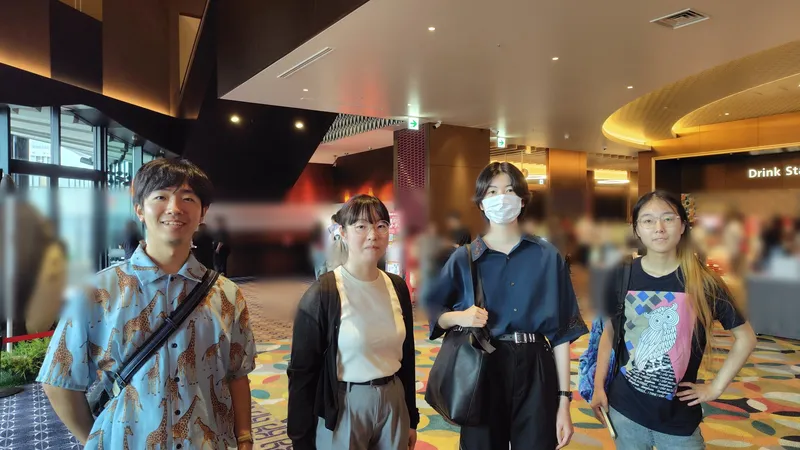
Ahead of the Japanese release on September 11, four of us from Humanitext went to an advance screening of Christopher Nolan’s The Odyssey.
After nearly three hours in the theater, we went to lunch. Over the meal the conversation turned to how this or that scene in the film is written in the original, and we talked for more than an hour.
I will not touch on the content of the film. Instead, here are three things that came up at the table.
What Did the Armored Giants Look Like in the Original?
Armored giants appear in the film. That they must be the Laestrygonians was settled at once over lunch. What kept us talking was the next question: did they look like that in the original?
The poem spends only a handful of lines on their appearance. The queen whom the three scouts meet in the palace is as tall as a mountain peak (Homer Odyssey 10.112–113), and her husband, King Antiphates, snatches up one of the companions and sets about preparing his meal (10.116). The inhabitants who gather are described only as “not like men but like Giants” (10.120); from the cliffs they hurl boulders too big for a man to lift, smashing the ships, then spear the men like fish and carry them off (10.121–124). What the original gives us is roughly their size, the stones they throw, and their habit of eating people. There is no armor, of course, but no faces and no clothing either. Before we can ask whether they wore armor, there is almost nothing to compare.
What Did Odysseus Hear in the Sirens’ Song?
The Sirens of the original do not tempt with sweet voices alone. “We know all that the Argives and Trojans suffered in wide Troy by the will of the gods, and we know all that happens on the fruitful earth” (12.189–191). What they offer is knowledge.
But the song recorded in the poem is these eight lines and no more. Odysseus wants to hear the rest and signals with his brows for his men to untie him, but they bind him tighter and the ship passes by (12.192–200). What they claimed to “know” is never sung, not one line. And the one narrating this scene is Odysseus himself, recalling his travels at the court of the Phaeacians. What he heard was not knowledge but the promise of knowledge. What did the Odysseus of the film hear?
Why Doesn’t the Story End When He Reaches Ithaca?
Of the poem’s twenty-four books, the second twelve take place after the homecoming. Odysseus steps onto the shore of Ithaca in Book 13. From there on, the story is not one of wandering but of winning back his house.
And on the night of their reunion, Odysseus tells his wife that he has not yet come to the end of all his trials, and foretells one more journey (23.248–250). In the original, arriving home and achieving a homecoming are not the same thing. Where the film chooses to end, I will leave unsaid.
Other questions came up too: where the film places the gods, and what Odysseus is carrying. I will leave those to Yuki Suzuki’s article.
For readers who want to know the original before seeing the film, Yuki Suzuki has written two pieces.
- The Odyssey: “Nostalgia” Was the Pain of Being Unable to Return
- Ask the Guest’s Name After the Meal: The “Law of Zeus” in the Odyssey
The Greek text with a parallel translation is available in Humanitext Reader. The passages above open at the Laestrygonians (Book 10), the Sirens’ song (Book 12), and the night of the reunion (Book 23). After the film, do open the original.
Related articles
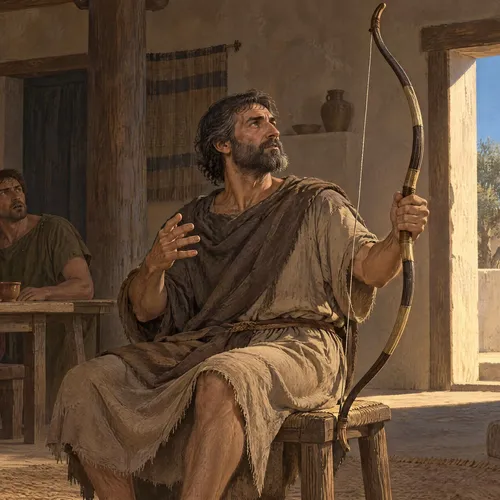
The God Who Makes Men Forget, the Man Who Will Not: The Ending of the Odyssey
For anyone left unsettled by the ending of the film The Odyssey. The original goes on after the suitors are killed, and it closes with a god making the people forget so that peace can follow. How did the film change that ending? Two endings, on forgetting and memory, read side by side from the lines of the poem (the film's ending is discussed).
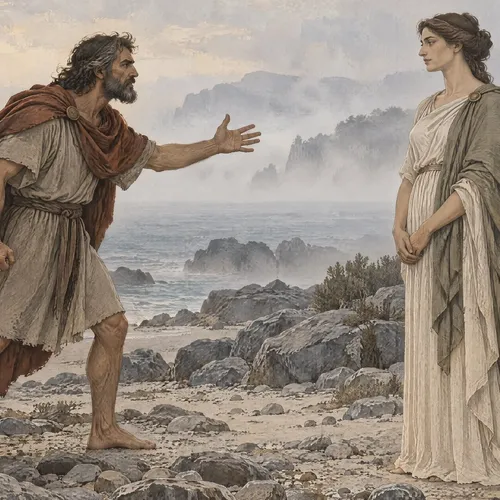
Athena in the Odyssey: How Do Homer and the Film Differ?
Why does the film's Athena neither save the hero nor blame him? Set her beside the goddess of the original, who shares her cunning with Odysseus and intervenes at every turn of his homecoming, and the film's design comes into focus.
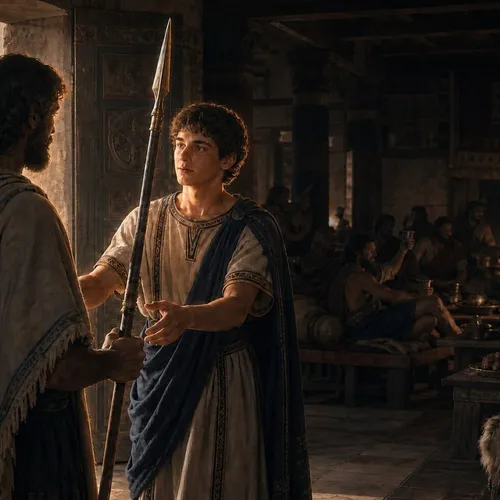
Ask the Guest's Name After the Meal: The “Law of Zeus” in the Odyssey
The suitors eat and drink their way through Odysseus's house. What is the “law of Zeus” that governs the treatment of guests? Scenes of hospitality in Homer's Odyssey show how a guest should be received, and how far the suitors have strayed from it.

DH2026: AI Translation and the Work of Building Research Infrastructure
Notes from DH2026 in Daejeon: presenting and fielding questions in Japanese with the aid of real-time AI translation, and reflecting on the distance between novelty in research and the less visible work of building infrastructure that scholars actually use.