

Athena in the Odyssey: How Do Homer and the Film Differ?
Why does the film's Athena neither save the hero nor blame him? Set her beside the goddess of the original, who shares her cunning with Odysseus and intervenes at every turn of his homecoming, and the film's design comes into focus.

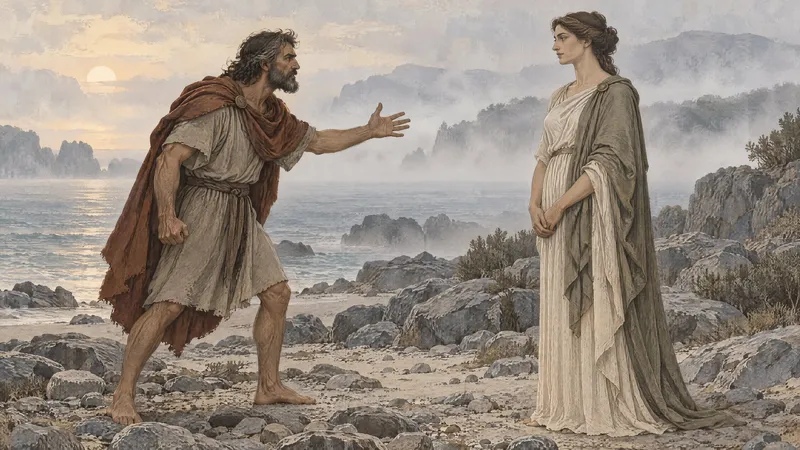
This article discusses the central events of the film The Odyssey.
For reading before you see the film, see Ask the Guest’s Name After the Meal: The “Law of Zeus” in the Odyssey and The Odyssey: “Nostalgia” Was the Pain of Being Unable to Return.
In the ancient Greek epic the Odyssey, Athena, goddess of wisdom, is portrayed as the one who guides and protects the hero Odysseus and his son Telemachus. The Athena of the film leaves a different impression. When Odysseus, on his harsh wanderings, is driven into a corner, she neither rescues him by a miracle nor gives him the power to strike down his enemies. She only appears from time to time and seems to watch how things will go for him.
Is this goddess a god who really exists in the world of the story, or a figure produced by the guilt of a man tormented by memories of the Trojan War? The film never reveals which. But there are questions we can think about without settling that one. Why does she not save him? And why does he refuse the words she offers him?
Follow the lines of the original poem carefully, and the craft of the film’s design comes into sharp relief. The puzzling behavior of the film’s Athena can be described as the framework of the original turned inside out. Holding the ancient epic and the modern film up to each other in turn, this article considers the figure of the goddess Athena in the Odyssey.
An Epic Where the Gods Show Themselves, a Film Where They Remain Uncertain
In Homer’s Odyssey, the gods show themselves from the very beginning. After the invocation to the Muse, the story moves to a council of the gods, where the decision is made to grant Odysseus his return home (Homer Odyssey 1.27–95). The story proceeds as the will of Odysseus to return and the intention of the gods to bring him back intertwine.
The Athena of the original does not merely appear before humans in disguise; she shapes their very decisions. Consider the departure of his son Telemachus. Visiting the house in the form of Mentes, an old friend of his father, the goddess tells him to fit out a ship and go in search of news of his father, and even specifies the route: first to Pylos, then to Sparta (1.279–285). Next, in the form of the old friend Mentor, she promises that she herself will provide the ship and crew (2.287–295); taking the form of Telemachus himself, she gathers the crew and borrows a ship (2.383–387), puts the suitors to sleep (2.393–398), and sends a wind to carry the ship out (2.420–421). When she leaves Pylos she flies off as a sea eagle, and only then does King Nestor realize that Telemachus’s companion was a goddess (3.371–379). Humans always notice too late that a god is there. But the idea of the journey, the means, and the timing of the departure were all the work of a god.
In the film, too, Telemachus sets out to find his father. But it is not a goddess who sends him. It is his own decision, and he sails against his mother’s wishes. His teacher Mentor is portrayed as a flesh-and-blood human being, who is ambushed at a temple and killed. Telemachus tells Mentor that he has “wise eyes. Athena’s eyes,” but Mentor is no god. The belief that gods take human form is thus preserved in the film, and it is also the basis of what the film calls “Zeus’s law.” But that people believe in the gods and that their existence can be confirmed are two different things. The Athena who appears before Odysseus likewise differs from the goddess of the original in that we are never told whether she is a god or an apparition.
Even so, the characters sense the work of the gods in what happens to them. The curse of the monster Polyphemus, and the terrible storm that strikes the fleet after it sails from Thrinacia, the island of the sun god, suggest the presence of a power beyond human understanding. The gods exist in the characters’ faith. But their forms cannot be directly verified.
On Calypso’s island, the film’s Odysseus vents his frustration at not knowing the gods’ intentions. “Why can’t gods speak in ways we understand?” he demands, and the Athena who appears to him answers: “Who doesn’t understand thunder? Or fire? A child’s smile? Or a good harvest?”
This reply urges him to find the words of the gods in the events of the world. Thunder and fire, a child’s smile and the harvest, can all be received as the speech of gods. But there is a modern device here that the original lacks. The original’s audience and readers know the council scene in which Athena negotiates with Zeus, and they do not doubt that the gods are beings with wills of their own. What the film’s audience is shown is only a scene in which they are told to “look” for something behind natural phenomena. The director, Christopher Nolan, has said that he depicted the gods in the way people of the time would have seen evidence of them, in nature and in the people around them (TIME, July 24, 2026). Without denying that the gods exist, the film hands its audience a circuit for reading events as symbols. This exchange will later be repeated on Thrinacia, in the form: “Who doesn’t understand pain? Or blood? Or death?”
This policy of not depicting divine power directly is carried through most thoroughly in Athena. The Athena of the original proposes the return at the council of the gods (1.44–95), arranges Telemachus’s journey, plots the destruction of the suitors on the beach (13.372–428), transforms Odysseus (13.429–438), and raises her aegis in the final battle (22.297–298). The Athena of the film provides no ship, applies no disguise, and lends no hand in the fight. All she does is ask: remember; look at the consequences. Of the work the goddess of the original performed, the film’s Athena performs almost none.
This is where the impression of “a goddess who never helps” comes from. Yet when we set the film against the original, a surprising fact emerges. The Odysseus of the original hurls the same complaint at her. Having reached the shore of his native Ithaca after twenty years, he presses the Athena who appears before him: you stood by me when I was at Troy, but after I set sail, in all my sufferings I never once saw you (13.316–321). To this complaint, the Athena of the original replies:
αὐτὰρ ἐγὼ τὸ μὲν οὔ ποτʼ ἀπίστεον, ἀλλʼ ἐνὶ θυμῷ
ᾔδεʼ, ὃ νοστήσεις ὀλέσας ἄπο πάντας ἑταίρους·
ἀλλά τοι οὐκ ἐθέλησα Ποσειδάωνι μάχεσθαι
πατροκασιγνήτῳ, ὅς τοι κότον ἔνθετο θυμῷ,
χωόμενος ὅτι οἱ υἱὸν φίλον ἐξαλάωσας.“But I never doubted this; in my heart I knew
that you would come home, having lost all your companions.
Yet I did not wish to fight with Poseidon,
my father’s brother, who stored up anger against you in his heart,
enraged that you had blinded his dear son.”(Homer Odyssey 13.339–343)
The goddess of the original was indeed absent from his side for a long time. But she had a reason for her absence. There was a clear defense, grounded in the order among the gods: to avoid a direct clash with Poseidon, the brother of her father Zeus. The source of Poseidon’s fierce grudge, which Athena names here, is the fight with the one-eyed giant Polyphemus, which the film also depicts.
The film reverses this relationship. The film’s Athena appears before him at the crucial points of his wanderings. But she does not say why she does not save him from his sufferings. The goddess who in the original “did not show herself, but explained why” becomes in the film one who “shows herself, but does not explain why she will not save him.” The impression that she does not help would seem to arise from this gap: she is right in front of him, and yet she does not reach out a saving hand.
Calypso brings this reversal in the portrayal of the gods into still sharper relief. In the original epic, the goddess who spends the longest stretch of the hero’s wanderings with him and keeps up a conversation with him is not Athena but the nymph Calypso. The Calypso of the original loves Odysseus and promises to make him an immortal god who will never age or die, but he sits on the shore in tears and firmly declines the offer, choosing to return to his mortal wife (5.135–136, 208–220). In the film, too, Calypso tells Odysseus that what the two of them have can last forever. “Forever is for gods,” Odysseus answers. “Are you a god?” She gives no reply. Calypso’s divinity, too, is kept ambiguous.
Compared with the original, which was a mythical story, the film The Odyssey might be said to be told as a human one.
The Athena of the Original Is an Accomplice
Let us look here at the bond that originally united her and Odysseus in the poem. It will also give us a clue to reading the strange Athena of the film. The relationship between the two is drawn most vividly on the shore of Ithaca, a little before the scene of complaint in Book 13 quoted above.
Waking from a long sleep, Odysseus stands at a loss on the fog-shrouded shore of his homeland, and Athena appears before him in the form of a young shepherd (13.221–225). Not knowing who this is, Odysseus stays on his guard, hides his identity, and launches into a long false tale: he is a fugitive from Crete, he says, who killed a man and fled. Far from being angry, Athena smiles with delight, strokes his hand gently, and takes on the form of a noble woman (13.287–289). Then she speaks to this man of cunning with affection.
ἀλλʼ ἄγε, μηκέτι ταῦτα λεγώμεθα, εἰδότες ἄμφω
κέρδεʼ, ἐπεὶ σὺ μέν ἐσσι βροτῶν ὄχʼ ἄριστος ἁπάντων
βουλῇ καὶ μύθοισιν, ἐγὼ δʼ ἐν πᾶσι θεοῖσι
μήτι τε κλέομαι καὶ κέρδεσιν·“Come, let us talk of this no longer, since we both
know cunning. You are by far the best of all mortals
in counsel and in speech, and I among all the gods
am famed for wit and cunning.”(Homer Odyssey 13.296–299)
The two of them in the original are accomplices who share in deception. The most cunning of men and the goddess most distinguished among the gods for wisdom and stratagem. They recognize each other as kindred spirits, and they are bound together deeply by sharing lies and schemes.
The peak of this complicity is the end of the Trojan War. The great wooden horse that led the Achaean army to victory was built by the carpenter Epeius, with the help of Athena’s wisdom, under Odysseus’s design (8.492–495). The very stratagem that ate through Troy from the inside was a joint work of Athena and Odysseus. According to the epic Little Iliad, Odysseus stole the Palladion, Athena’s statue that protected the city, from the sanctuary of Troy (Little Iliad arg. 4 West). He seized Athena’s symbol, brought her over to his side, and with the goddess caught the city in a trap.
What, then, of the desecration of the temple that angered Athena? Odysseus does not appear as the chief culprit in that story. In the relevant traditions it was another commander, the so-called Lesser Ajax, who violated Cassandra as she begged Athena for protection, and so provoked the goddess’s anger (Euripides Trojan Women 69–71; Apollodorus Epitome 5.22). What is more, the goddess’s anger falls not on the individual who committed the sacrilege but on the army as a whole. The original speaks of the “grievous wrath of the bright-eyed daughter” (Athena) that fell on many of the Greeks (Homer Odyssey 3.135). In Euripides’ tragedy Trojan Women, too, Athena, her temple defiled, joins with Poseidon to shatter the returning Greek fleet with a storm (Euripides Trojan Women 75–97).
Book 5 of the Odyssey also contains an explanation that links the offense against Athena with the shipwreck on the way home. Hermes, visiting Calypso’s island, tells how Odysseus came to be washed up there.
οἴκαδʼ· ἀτὰρ ἐν νόστῳ Ἀθηναίην ἀλίτοντο,
ἥ σφιν ἐπῶρσʼ ἄνεμόν τε κακὸν καὶ κύματα μακρά.
ἔνθʼ ἄλλοι μὲν πάντες ἀπέφθιθεν ἐσθλοὶ ἑταῖροι,
τὸν δʼ ἄρα δεῦρʼ ἄνεμός τε φέρων καὶ κῦμα πέλασσε.“[After sacking Troy, they set out] for home. But on the way they sinned against Athena,
and she roused an evil wind and long waves against them.
There all the rest of his noble companions perished,
and him alone the wind and the wave carried and brought here.”(Homer Odyssey 5.108–111)
Those said to have sinned here are “they.” That Odysseus suffered the disaster and that he himself carried out the desecration of the temple are not the same thing. Even the hero Athena protects is placed inside a calamity that strikes the whole army.
In the original, the stratagem of the horse and the desecration of the temple were the deeds of different people. The film folds the two into a single scene. The army that sends in the horse under the pretense of an offering to Athena kills the people of Troy and destroys the goddess’s statue as well. The priestess killed in the temple and the head of Athena’s statue rolling to the floor are shown as one continuous sequence. Through this juxtaposition, the death of a living woman and the destruction of the divine image are made to overlap. And after the sack, the Athena who appears before Odysseus has the face and form of the priestess killed that night. The scheme plotted together with the goddess in the original, and the sacrilege that angered her, become in the film things born of the same man’s idea, on the same night, in the same place.
Odysseus, who in the epic shares his cunning with Athena and was not the chief culprit of her anger, is portrayed in the film as a man who takes on himself the responsibility for the destruction and killing his idea brought about. The soldiers carry it out, but in the confession scene he calls it “one man’s idea, one man’s trick,” and tries to bear the responsibility alone. His relationship with the goddess changes from the intimacy of shared scheming into something inseparable from his memory of the harm he did.
From this contrast, the strangeness of the film’s Athena comes into view. The goddess who in epic and tragedy wields the power to destroy an army stands before Odysseus in the film in the form of a murdered woman. That form should confront him with the memory of his guilt. And yet she never speaks a word of blame.
A Man Who Refuses the Voice That Defends Him
If the film’s Athena does not blame him, what is she offering him? The key to this puzzle is embedded at the very head of Homer’s Odyssey, in the few lines of its proem.
ἀλλʼ οὐδʼ ὣς ἑτάρους ἐρρύσατο, ἱέμενός περ·
αὐτῶν γὰρ σφετέρῃσιν ἀτασθαλίῃσιν ὄλοντο,
νήπιοι, οἳ κατὰ βοῦς Ὑπερίονος Ἠελίοιο
ἤσθιον· αὐτὰρ ὁ τοῖσιν ἀφείλετο νόστιμον ἦμαρ.“But even so he could not save his companions, much as he longed to,
for they perished by their own reckless folly,
the fools, who ate the cattle of Helios Hyperion,
and he took from them the day of their homecoming.”(Homer Odyssey 1.6–9)
The syntax of this opening deserves careful attention. The poet places here a strong concessive phrase, “much as he longed to” (ἱέμενός περ), and follows it with the words “by their own reckless folly” (αὐτῶν σφετέρῃσιν ἀτασθαλίῃσιν). This introduction, which governs the whole epic, is written as a powerful logic of exoneration for Odysseus. That his men all perished was not the fault of their captain, but the result of their own folly. And the poet nails that folly down to one specific act: eating the cattle of the sun god.
The view that locates the cause of disaster in human folly itself reappears in the council of the gods that follows. Zeus says that mortals blame the gods for their troubles, when in fact it is by their own folly that they bring on themselves sufferings beyond what is fated (Homer Odyssey 1.32–34). This is not a defense of Odysseus as an individual, but like the proem it turns our eyes to the responsibility of those who brought the disaster on themselves.
And the film revives precisely this logic of the proem, as the words of Athena.
On Thrinacia, after his companions, unable to bear their hunger, slaughter the forbidden cattle and eat the meat, Athena appears before Odysseus. “What if their deaths aren’t your failing,” she asks, “but theirs?” This is the same logic as the proem. They perished by their own folly. He longed to save them and could not. The exoneration that the original’s narrator wrote for the hero, the film puts in the mouth of the goddess.
But Odysseus rejects it. He led them, he says; he brought them here. Athena’s final questions are sharp. Then who led you? “Why do you put yourself above the gods?” Why do you want to keep all the responsibility for yourself? Why do you not want to go home? Her words are less a consolation than a challenge to the refusal of exoneration itself. The film’s hero rejects with his own hands the defense the original prepared, and that rejection keeps him from his homecoming. What the film’s Athena offers is not forgiveness but this dilemma.
We can now return to the question set aside at the start: is Athena a real god, or a psychological projection of the hero? The reason there is no need to settle it is by now clear.
If she is a real goddess, then a human being is refusing an exoneration offered by a god. If she is a projection of Odysseus’s inner life, then he himself is rejecting the self-justifying voice that says “it was not your fault.” On either reading, the fact that he cannot accept exoneration is unchanged. What he is resisting is the very voice that would release him from responsibility.
In the Dimness of Ithaca
Having refused exoneration in words, Odysseus faces Athena in a different way in the house on Ithaca.
In the epic’s explanation seen above, the offense against Athena brought about the shipwreck on the way home. If, on the other hand, we read the film’s Athena and her questions as a response to his suffering, the focus shifts from divine punishment to the suffering of a human being who cannot accept exoneration. Odysseus’s wanderings seem to be layered not only with external obstacles to his return, but also with a guilt that will not allow him to be saved.
Still in the form of an unknown old guest, Odysseus begins to tell his wife Penelope of the violence and slaughter at Troy. Without naming himself as her husband, speaking as a nameless old man, his words sound less like a plea justifying his deeds than like a confession of guilt. And as he speaks, tears fall from his eyes.
Then, as if witnessing that confession, tears quietly well up in the eyes of Athena as she stands beside him. Without a word, the two gently lay their hands together.
He had violently rejected the view offered on Thrinacia that their deaths were not his failure. But in the dimness of Ithaca, he accepts the tears that the goddess, in the form of the murdered priestess, sheds without a sound.
To the end, she never says “I forgive you.” In the scene where the two weep and join hands, there are no words to decide the question of guilt. And yet it is here that Odysseus seems, for the first time, to accept consolation. The man who refused the words that denied his guilt reaches out to a presence that stays beside his pain.
A Token That Cannot Be Moved, and One That Can Be Carried
Athena is also involved in the reunion of husband and wife that follows this confession.
In the original, Penelope herself announces to her husband, in his beggar’s disguise, that she will wait no longer and will set the contest of the bow before the suitors (19.570–581). And the next morning, at the moment she carries it out, the poet says that “the bright-eyed goddess Athena put it in her mind” (21.1–4). Human decision and divine prompting overlap to move events forward, in the manner characteristic of this epic. The film removes this divine layer. The wife who has heard the confession of guilt stops waiting on the spot and declares that tomorrow she will choose a husband: gather the suitors, and she will marry the one who completes the trial. What a god was supposed to have put in her mind is replaced by the will of a wife who has taken in Odysseus’s words. The same substitution that sent the son to sea against his mother’s wishes happens here too.
The clue by which husband and wife confirm each other also differs between original and film. In Book 23, Penelope keeps up her guarded stance even before the husband who has slaughtered the suitors, and she tests his reaction by ordering the nurse to carry the bed out of the bedroom (23.177–180). Odysseus is angered and answers that the bed cannot possibly be moved, for it was he himself who trimmed the trunk of an olive tree rooted in the earth into a bedpost and built the bedroom around it (23.183–204). This bed holds the “great token,” the sure proof, by which the couple confirm each other (23.188, 202). What binds the two here is not only the immovable bed itself, but the memory they share of how it was made.
By contrast, the reunion in the film rests on a small statue of Athena that can be carried anywhere. Penelope handed Odysseus this statuette when he left for the war, and he never lets go of it, through the fighting at Troy, the wanderings at sea, and the days on Calypso’s island. It reminds him of his wife as he gropes through dim memories with Calypso, and after the slaughter of the suitors it is returned from his hand to hers. The statue he smashed in the temple at Troy and the statuette that kept his connection with his wife alive across the sea both represent the same Athena. For him, the goddess is bound up with both the memory of the war and the bond of marriage. Might it be precisely because Athena was also the goddess who sustained his bond with his wife that Odysseus was so deeply held by his offense against her? The sequence in which the confession leads to the return of the statuette can be read as the process by which he recovers his relationship with his wife while facing that guilt.
Human Confession Where Divine Intervention Used to Be
The Athena of the original was a goddess who proposed the return at the council of the gods, arranged the son’s journey, plotted the destruction of the suitors, and joined the fight. The narrator of the proem defended the hero by declaring that his companions’ deaths were due to their own folly. The film puts a human decision and a human response in each of the places where a god once intervened. The son defies his mother and sets out on his own; the wife hears the confession and stops waiting on her own. All that is left for the one remaining goddess to do is to hold out to the hero the exoneration the original narrator prepared. And the film’s hero refuses it. If the god is real, he is refusing a god’s defense; if she is an inner voice, his own. The film’s Athena seems not to help because the work of helping has been transferred to the human side, and only the asking is left to her.
This substitution has a price. In the original, human beings, however wise, are in the end in the hands of the gods. It is Zeus’s decision that permits the return (1.76–79), and it is the gods who stop the blood feud after the killing of the suitors and bring about reconciliation (24.472–486, 529–548). It is the poet and the gods, not humans, who define the companions’ deaths as “their own folly.” Human beings cannot take on everything they have done, and they need not. That sense of limits in the original recedes into the background in the film. What is interesting is that the film itself seems aware of the price. What Athena asks on Thrinacia is precisely this: “Why do you put yourself above the gods?” The man who tries to bear all the responsibility alone is at once a humble human refusing exoneration and a human who has set himself in the seat of a god. That what the film finally gives him is not forgiveness but exile is surely not unrelated to that ambiguity.
Nor does it follow that the film endorses his refusal. Even once the reunion of husband and wife is achieved, whether the tears shared with the goddess can simply be called a reconciliation with the victims is a separate question. The goddess who consoles him has the form of the priestess murdered at Troy. Can Athena’s words and tears be taken as the will of that woman herself? The staging, in which only he can see her, also leaves the suspicion that she is a projection of his own wish. A presence in the form of the victim weeps beside the man who did the harm. That picture can look like consolation for a human being facing his guilt, and it can look like the wish of a perpetrator to be saved. Between his accepting consolation and the victims’ forgiving him, a gap still remains.
The film shows that gap in a single cut. When the flashback returns to the present, the hand that had been holding the goddess’s is grasping empty air. The next time you watch this film, pay attention to how he responds to Athena’s words, and to what changes in the scene of tears. The hands the two lay together are a gesture of accepting consolation, but not a proof that the guilt is gone.
Related articles: Ask the Guest’s Name After the Meal: The “Law of Zeus” in the Odyssey / The Odyssey: “Nostalgia” Was the Pain of Being Unable to Return
More on The Odyssey on Screen and in Homer
The God Who Makes Men Forget, the Man Who Will Not: The Ending of the Odyssey
For anyone left unsettled by the ending of the film The Odyssey. The original goes on after the suitors are killed, and it closes with a god making the people forget so that peace can follow. How did the film change that ending? Two endings, on forgetting and memory, read side by side from the lines of the poem (the film's ending is discussed).
Ask the Guest's Name After the Meal: The “Law of Zeus” in the Odyssey
The suitors eat and drink their way through Odysseus's house. What is the “law of Zeus” that governs the treatment of guests? Scenes of hospitality in Homer's Odyssey show how a guest should be received, and how far the suitors have strayed from it.
The Odyssey: “Nostalgia” Was the Pain of Being Unable to Return
The opening lines of the poem behind the film The Odyssey hold the two words that would later give us “nostalgia”: homecoming and pain. A guide to the original, where the hero weeps on a shore he cannot leave, and endures.
Why Ancient Greeks Hated Philosophers: The Harshest Insults
Socrates was mocked as a poor chatterbox, and philosophers were dismissed as useless in real life. These ancient Greek and Roman insults reveal the irritation and unease that professional thinkers provoked.