

Ask the Guest's Name After the Meal: The “Law of Zeus” in the Odyssey
The suitors eat and drink their way through Odysseus's house. What is the “law of Zeus” that governs the treatment of guests? Scenes of hospitality in Homer's Odyssey show how a guest should be received, and how far the suitors have strayed from it.

Watching the film The Odyssey, you may feel something is off about the suitors, who have taken over a house whose master is absent and who drink its wine and eat its meat to the last scrap. Why can strangers walk into someone else’s home while the owner is away and behave so outrageously? To modern eyes they look like nothing more than shameless freeloaders who have moved into a house they were never invited to and keep eating and drinking. And there are not just one or two of them. When Telemachus counts them, more than a hundred men have gathered from Ithaca and the neighboring islands (Homer Odyssey 16.245–253).
Ancient Greece had a custom of receiving and entertaining the stranger who arrived at one’s door. This bond between guest and host was called xenia, and it was thought to be backed by none other than Zeus in one of his aspects: Zeus Xenios, protector of guests. This article considers the behavior of the suitors through the “hospitality” depicted in the Odyssey. Compare the scenes of welcome that take place across the poem, at the door of the great house, in the swineherd’s hut, in the giant’s cave, and it becomes clear how far the suitors, camped in the house indefinitely, stand from all of them.
A Guest at the Door and the “Procedure of Hospitality”
At the opening of the Odyssey, in Odysseus’s house, the suitors of Queen Penelope are sitting on the hides of the cattle they have slaughtered, amusing themselves with games while servants bring them wine and meat (Homer Odyssey 1.106–112). At the door of this noisy house stands a figure who, to Telemachus, looks like an unknown traveler, holding a bronze spear (1.103–105).
The young son, sitting dejected among the suitors, notices that the stranger has been standing at the door for some time. Ashamed in his heart, he walks straight to the doorway (Homer Odyssey 1.113–120).
From here the poem goes into detail. Telemachus takes the guest’s right hand and receives the bronze spear from it (Homer Odyssey 1.121). He carries the spear to a fine spear-stand and sets it where many of his father Odysseus’s spears stand together (1.127–129). He then leads the guest away from the din of the suitors to a chair spread with a beautiful cloth and sits down beside him (1.130–135). Water is poured from a golden jug into a silver basin so the guest can wash his hands, and bread, meats of every kind, and golden cups are set out unstintingly on a polished table (1.136–143).
At the moment of welcome, this is what he says:
χαῖρε, ξεῖνε, παρʼ ἄμμι φιλήσεαι· αὐτὰρ ἔπειτα δείπνου πασσάμενος μυθήσεαι ὅττεό σε χρή.
“Welcome, stranger. You shall be treated kindly among us. Then, when you have had your meal, tell us what you need.”
(Homer Odyssey 1.123–124)
Telemachus asks his guest who he is only after the meal is over and the bard has begun to play the lyre. Leaning his head close to the guest’s so that no one else can hear, he asks for the first time, in a low voice, who he is, where he is from, and on what ship he came (1.156–177). Here the act of receiving the visitor as a guest comes before any question about his identity.
A Slave Who Slaughters Pigs, and a King Who Sends His Guest Home
It is not only princes like Telemachus who follow this order.
Returning to his native Ithaca after twenty years, Odysseus, in the shape of a shabby old man, comes to the hut of his loyal swineherd Eumaeus. When the stranger is about to be set upon by fierce dogs, Eumaeus drives them off with a stone and invites him into his humble hut (Homer Odyssey 14.29–48). He spreads brushwood and lays the hide of a wild goat over it for the old man to sit on (14.49–51). He still knows nothing about who his visitor is.
Eumaeus says that even if someone more wretched than this stranger were to come, it would not be right to treat a guest with contempt, since all guests and beggars come from Zeus (Homer Odyssey 14.56–58). He slaughters two young pigs and roasts them on spits, sprinkles the meat with barley, serves it still hot on the spits, and pours sweet wine into an ivy-wood cup (14.73–78). For supper he slaughters a well-fattened five-year-old boar, makes an offering to the gods, and honors his guest with the whole length of the best cut, the chine (14.418–438).
For this swineherd, receiving a guest was a matter that touched his own reputation and his relationship with Zeus. The guest predicts Odysseus’s return and offers that, if it does not come true, Eumaeus should kill him (Homer Odyssey 14.391–400). Eumaeus answers with irony.
ξεῖνʼ, οὕτω γάρ κέν μοι ἐϋκλείη τʼ ἀρετή τε εἴη ἐπʼ ἀνθρώπους ἅμα τʼ αὐτίκα καὶ μετέπειτα, ὅς σʼ ἐπεὶ ἐς κλισίην ἄγαγον καὶ ξείνια δῶκα, αὖτις δὲ κτείναιμι φίλον τʼ ἀπὸ θυμὸν ἑλοίμην· πρόφρων κεν δὴ ἔπειτα Δία Κρονίωνα λιτοίμην.
“Stranger, a fine name and a fine reputation I would have among men, now and ever after, if, having brought you into my hut and given you a guest’s welcome, I then killed you and took your dear life. With a glad heart I could pray to Zeus, son of Cronus, after that!”
(Homer Odyssey 14.402–406)
The swineherd’s earnest hospitality can be read directly, in the Greek with a parallel translation, in Humanitext Reader, Book 14.
Hospitality is not complete once the guest has been entertained. In Book 15, Menelaus, king of Sparta, tells Telemachus, who wants to go home, that one must treat a guest kindly while he is there, and send him on his way when he wishes to leave (Homer Odyssey 15.74). Menelaus does not press Telemachus to stay. He brings out a silver mixing-bowl as a gift (15.113–120), his wife Helen gives him a beautiful robe to take with him, and they see him off gladly (15.123–130).
In this poem, hospitality does not mean keeping a guest in the house forever. Entertaining him while he stays and sending him off when he leaves form one continuous sequence.
Scenes Where Hospitality Fails
This sequence of welcome, entertainment, and send-off stands out all the more sharply in the portrayal of those who invert it.
On the island where Odysseus and his men land in Book 9 is the cave of the one-eyed giant Polyphemus. Inside, cheeses and lambs are neatly arranged, and Odysseus waits in the hope that the master will return and give his guests a gift (Homer Odyssey 9.218–229). But the monster who comes back seals the entrance with a huge rock (9.240–243), lights a fire, and the moment he catches sight of the men, opens with these words:
ὦ ξεῖνοι, τίνες ἐστέ; πόθεν πλεῖθʼ ὑγρὰ κέλευθα; ἦ τι κατὰ πρῆξιν ἦ μαψιδίως ἀλάλησθε, οἷά τε ληιστῆρες, ὑπεὶρ ἅλα, τοί τʼ ἀλόωνται ψυχὰς παρθέμενοι κακὸν ἀλλοδαποῖσι φέροντες;
“Strangers, who are you? From where do you sail the watery ways? Is it on some business, or do you wander at random, like pirates over the sea, who roam about staking their own lives and bringing harm to men of other lands?”
(Homer Odyssey 9.252–255)
The question Telemachus held back until after the meal comes first here. And what follows “who are you?” is the suspicion that they are raiders. When Odysseus appeals to him to respect Zeus, who watches over guests and suppliants (9.269–271), the giant pays no heed. He seizes two of the companions, dashes them on the floor like puppies, and devours them, bones and entrails and all (9.288–293). The question comes first, and the hospitality never comes.
There is another form the inversion takes: when the one received as a guest betrays the relationship. Paris (Alexander), the Trojan prince of the Iliad, is no monster who turns guests away by force. Received as a guest in the house of Menelaus and lavishly entertained, he made off with Menelaus’s wife Helen and the treasures of the house. In Book 3, as Menelaus goes out to single combat with Paris, he prays to Zeus that even men born in later ages may shudder at doing evil to a host who has shown them the kindness of hospitality (Homer Iliad 3.351–354). Polyphemus and Paris. The twisting of the relationship in these two scenes is not only a matter of a host refusing a guest. When the one received as a guest betrays his host, hospitality has failed just the same.
The Suitors Outside Hospitality
If the scenes we have looked at are the measure, where do the suitors settled in Odysseus’s house fall?
They do not, like Polyphemus, refuse guests and eat them. Nor, like Paris, do they leave with the wife and the treasure. What the poem writes about the suitors, again and again, is the scene of them drinking, eating, and slaughtering. According to the swineherd Eumaeus, the vast estate their master held on the mainland, twelve herds each of cattle, sheep, pigs, and goats, together with eleven herds of goats on Ithaca itself, was being consumed by their feasting (Homer Odyssey 14.96–108). Of the pigs Eumaeus raises, the fattest is carried off each time (14.16–20).
In Book 1, Telemachus complains to the guest at the door that the suitors are eating through another man’s livelihood without paying for it (Homer Odyssey 1.160). That guest, as the poem’s audience already knows, is the goddess Athena in the form of Mentes, leader of the Taphians (1.102–105). Telemachus himself realizes that his guest may have been a god only at the moment of parting, when the visitor flies off like a bird (1.319–323). Telemachus openly declares to the suitors that they should leave the house and feast on their own property, or else he will pray to Zeus for their destruction (1.374–380). As words spoken by the master of a house to his guests, they are a long way from the “Welcome, you shall be treated kindly among us” that Telemachus offered the traveler at the door.
The guest Telemachus received had a hand to take his spear, a seat, a meal, and finally a moment when he was asked his name. Menelaus’s guest had a day when he was given gifts and sent on his way. In the case of the suitors, what the poem keeps writing is only the table in the middle.
Why could Telemachus and Penelope not throw them out at once? The answer cannot be drawn from the etiquette of hospitality alone. For one thing, the suitors are simply too many for them to handle. But that their behavior lies far from the proper way of a guest, as this poem depicts it again and again, becomes visible once the scenes are set side by side.
When you watch The Odyssey and come across a scene in which someone is received as a “guest,” pay attention to what is done there, and how. To look more closely at the words of hospitality the characters exchange, put your questions to the original text in Humanitext Antiqua.
More on The Odyssey on Screen and in Homer
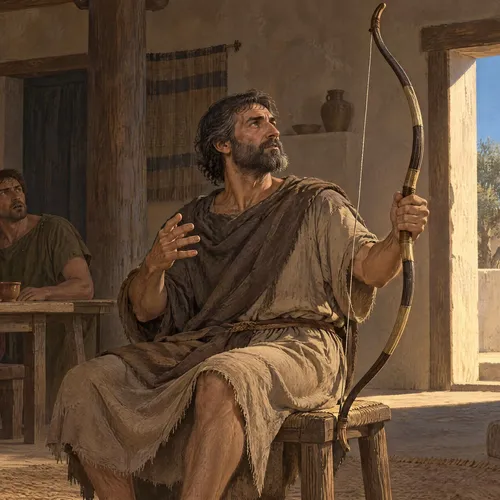
The God Who Makes Men Forget, the Man Who Will Not: The Ending of the Odyssey
For anyone left unsettled by the ending of the film The Odyssey. The original goes on after the suitors are killed, and it closes with a god making the people forget so that peace can follow. How did the film change that ending? Two endings, on forgetting and memory, read side by side from the lines of the poem (the film's ending is discussed).
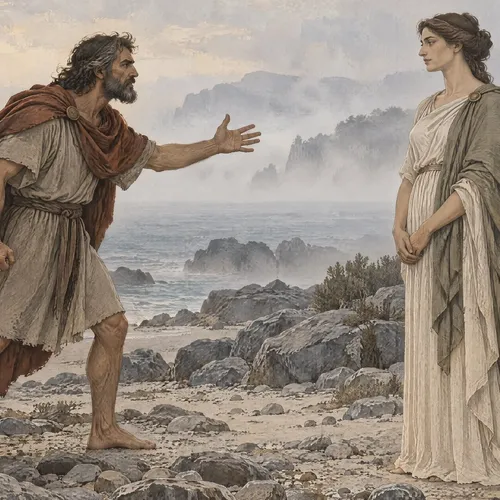
Athena in the Odyssey: How Do Homer and the Film Differ?
Why does the film's Athena neither save the hero nor blame him? Set her beside the goddess of the original, who shares her cunning with Odysseus and intervenes at every turn of his homecoming, and the film's design comes into focus.

The Odyssey: “Nostalgia” Was the Pain of Being Unable to Return
The opening lines of the poem behind the film The Odyssey hold the two words that would later give us “nostalgia”: homecoming and pain. A guide to the original, where the hero weeps on a shore he cannot leave, and endures.

Why Ancient Greeks Hated Philosophers: The Harshest Insults
Socrates was mocked as a poor chatterbox, and philosophers were dismissed as useless in real life. These ancient Greek and Roman insults reveal the irritation and unease that professional thinkers provoked.