

The Odyssey: “Nostalgia” Was the Pain of Being Unable to Return
The opening lines of the poem behind the film The Odyssey hold the two words that would later give us “nostalgia”: homecoming and pain. A guide to the original, where the hero weeps on a shore he cannot leave, and endures.

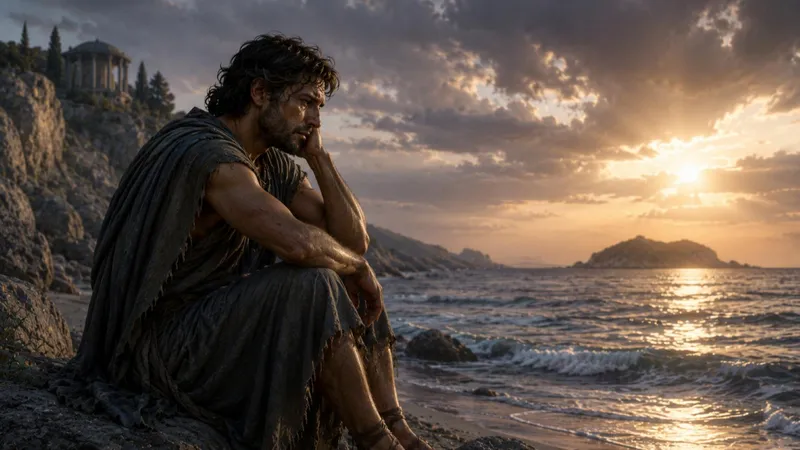
Many people who saw the trailer for The Odyssey, which opens in Japan on September 11, 2026, will have found themselves curious about the ancient Greek hero’s tale behind it. A raging sea, a giant one-eyed monster, a witch who turns sailors into animals. It is easy to picture an action adventure in which the hero breaks through one obstacle after another by wit and force of arms. But if those images send you to the original poem, composed some 3,000 years ago, a somewhat different story is waiting.
Even the fight to the death with the one-eyed giant, so striking in the trailer, is only a brief episode when set against the poem as a whole. What the epic’s twenty-four books depict is not an invincible hero mowing down monsters. What Homer, the great poet of ancient Greece, set down was one man who has all but lost the place he should return to, who is held back for an unimaginable span of years, and who goes on enduring even as he breaks down weeping on a beach.
The Hero Does Not Appear Until Book 5
Odysseus, the hero of the adventure, does not appear as soon as the story begins. The first four of the twenty-four books are given over to the wretched state of Ithaca, the homeland he left behind, and to the anguish of his son Telemachus.
Telemachus has never seen his father’s face, since Odysseus left for the war just after he was born. Now around twenty, he lives among people who already count Odysseus as dead and say that his bones lie rotting somewhere at the bottom of the sea (Homer Odyssey 1.161–168). More than a hundred suitors have installed themselves in the house, pressing his mother Penelope to marry, slaughtering the livestock day after day, draining the wine cellar, and eating through the estate (Homer Odyssey 1.106–112; 2.237–238; 16.245–253).
Only when the story reaches Book 5 does the scene at last shift to Ogygia, the remote island where Odysseus is held. Hermes, messenger of the gods, descends to the island and visits Calypso’s cave (Homer Odyssey 5.43–58). Fragrant wood burns on the hearth, and the nymph sings beautifully as she weaves with a golden shuttle (Homer Odyssey 5.59–62). But the man is not there.
οὐδʼ ἄρʼ Ὀδυσσῆα μεγαλήτορα ἔνδον ἔτετμεν, ἀλλʼ ὅ γʼ ἐπʼ ἀκτῆς κλαῖε καθήμενος, ἔνθα πάρος περ, δάκρυσι καὶ στοναχῇσι καὶ ἄλγεσι θυμὸν ἐρέχθων. πόντον ἐπʼ ἀτρύγετον δερκέσκετο δάκρυα λείβων.
“But great-hearted Odysseus he did not find within. He was sitting on the shore and weeping, where he always sat, rending his heart with tears and groans and pain, and gazing out over the barren sea, shedding tears.”
(Homer Odyssey 5.81–84)
The poet spends four whole books driving home the weight of the hero’s absence. And the hero who finally appears at the end of them is not a warrior brandishing a spear, but a man who cannot stop weeping as he stares at a sea he cannot cross.
The Famous Adventures Are Told by Odysseus Himself
Ask anyone what the title Odyssey calls to mind, and the answer will probably be the battles with fantastic monsters: the blinding of the one-eyed giant Polyphemus, the house of the witch Circe who turns men into animals, the Sirens luring sailors to their deaths with their beautiful song, and the journey to the underworld where the spirits of the dead gather.
But these famous adventures share one major feature. The poem’s narrator does not present them as events reported from the outside. Every one of them is a story told by Odysseus himself, at a banquet, about his past.
After escaping Calypso’s island, Odysseus is caught in a storm and washed up on the island of the Phaeacians. There he is received as a guest while keeping his identity hidden, and only when pressed at the feast does he at last reveal his name and begin to tell of his wanderings (Homer Odyssey 9.1–38).
εἴμʼ Ὀδυσεὺς Λαερτιάδης, ὃς πᾶσι δόλοισιν ἀνθρώποισι μέλω, καί μευ κλέος οὐρανὸν ἵκει.
“I am Odysseus, son of Laertes, known among all men for my stratagems, and my fame reaches the heavens.”
(Homer Odyssey 9.19–20)
What he boasts of is not exceptional strength or prowess in battle, but the cunning by which he has survived. The terrible adventures from his departure from Troy to the loss of all his companions and his landing on the lonely island are contained in just four books, 9 through 12, and in his own words. When his long tale ends, the hall falls into a deep silence, the listeners spellbound and unable to speak (Homer Odyssey 13.1–2).
The confrontations with monsters come neither at the beginning nor at the end of the poem. They are a flashback set into its middle. A structure that separates the order in which events happened from the order in which they are told was already built into a work composed some 3,000 years ago. The Greek text of this scene, including his declaration of his name, can be read alongside a translation in Humanitext Reader.
Eighty Percent of the Wandering Is Spent on the Same Island
Odysseus’s wanderings after the Trojan War are often described as “ten years adrift at sea.” But there is no line in the poem that says he wandered the sea for ten years.
The figure is arrived at by combining two things: the statement that he fought at Troy for nine years and sacked the city in the tenth before setting out for home (Homer Odyssey 5.106–107), and the prophecies and testimonies that he would reach home in the twentieth year after his departure (Homer Odyssey 2.175–176; 16.206; 19.222–223).
Trace how those ten years break down in the poem, and a still more surprising fact emerges. He was not rowing the whole time. Most of those years he spent unable to move, on just two islands.
He remained on Calypso’s island of Ogygia for a full seven years, and was allowed to leave only when the eighth had begun (Homer Odyssey 7.259–263). Before that, he had spent a whole year in the house of the witch Circe (Homer Odyssey 10.467–470).
Do the sum, and eight of the ten years were spent stranded in the same place. That is fully eighty percent of the wandering.
The wandering this poem depicts is not a voyage that keeps cutting through the waves. It is stagnation itself: time passing while a man who longs to go home cannot. The figure weeping on the beach in the first section was not one extraordinary day of turmoil. It was an everyday scene, repeated without end for seven years.
The Second Half of the Poem Is the Fight After Coming Home
Even once the sea of monsters is behind him, the story does not end. Odysseus sets foot on his native Ithaca in Book 13 (Homer Odyssey 13.116–119). Of twenty-four books, that is exactly the halfway point.
The remaining twelve books depict the fight of a man who has reached home to take back what was taken from him. But the way he fights is nothing like a glorious triumph.
On landing, Odysseus is transformed by the goddess Athena into a wretched old man (Homer Odyssey 13.429–438). Entering his own house with his identity concealed, he begs from the feasting suitors and is insulted by them. He keeps up the disguise because he and the goddess have been working out how to destroy the suitors (Homer Odyssey 13.386–391). Immediately after his landing, the goddess had ordered him to reveal himself to no one and to endure many sufferings in silence (Homer Odyssey 13.307–310). When the leader of the suitors hurls a wooden footstool at his shoulder, he stands firm as a rock, shaking his head without a sound and sinking his anger deep in his breast (Homer Odyssey 17.462–465).
At night, when he sees the maids of the house dallying with the suitors, the heart in his chest barks like a dog. He strikes his breast and scolds his own heart: “Endure, my heart. You once endured something even more shameless than this.” (Homer Odyssey 20.17–21).
Harsher still is his meeting with his beloved wife Penelope. Though she weeps bitterly before him, lamenting her husband’s absence, he cannot reveal who he is. He does not allow himself even to shed a tear; he holds his eyes steady as if they were made of horn or iron, and keeps his feelings buried (Homer Odyssey 19.209–212).
Setting foot on the soil of home, he had not yet taken back a single thing.
At the head of this poem stands the word νόστος (nostos, homecoming) (Homer Odyssey 1.5, 13). For Odysseus, nostos was not simply a matter of returning to his homeland on the map. Homecoming meant recovering his wife, his son, and his aged father, and recovering the place he had held as head of a family and as king before he left for the war.
Those opening lines carry one more important word: ἄλγος (algos, pain), for the sufferings he heaped up on the sea (Homer Odyssey 1.4). Later, the two words “homecoming” (nostos) and “pain” (algos) were joined to form the word we use today: “nostalgia.”
This pain, algos, did not live only in the moments of fighting monsters. The scene quoted in the first section, the figure on Calypso’s island gazing at the sea “rending his heart with tears and groans and pain (algos)” (Homer Odyssey 5.83), was the very heart of this story.
What this epic depicts is not a flawless hero who overpowers mighty monsters, but a person who endures, in tears, in order to recover his home and family. Open the words of the original and see for yourself the journey the ancient poet drew. If there are details of the text you would like to know more about, you can ask Antiqua.
More on The Odyssey on Screen and in Homer
The God Who Makes Men Forget, the Man Who Will Not: The Ending of the Odyssey
For anyone left unsettled by the ending of the film The Odyssey. The original goes on after the suitors are killed, and it closes with a god making the people forget so that peace can follow. How did the film change that ending? Two endings, on forgetting and memory, read side by side from the lines of the poem (the film's ending is discussed).
Athena in the Odyssey: How Do Homer and the Film Differ?
Why does the film's Athena neither save the hero nor blame him? Set her beside the goddess of the original, who shares her cunning with Odysseus and intervenes at every turn of his homecoming, and the film's design comes into focus.
Ask the Guest's Name After the Meal: The “Law of Zeus” in the Odyssey
The suitors eat and drink their way through Odysseus's house. What is the “law of Zeus” that governs the treatment of guests? Scenes of hospitality in Homer's Odyssey show how a guest should be received, and how far the suitors have strayed from it.
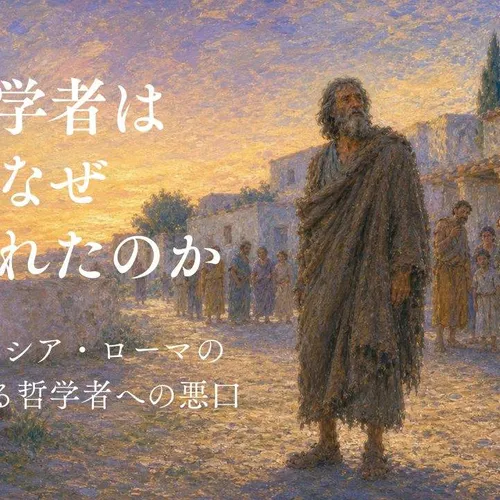
Why Ancient Greeks Hated Philosophers: The Harshest Insults
Socrates was mocked as a poor chatterbox, and philosophers were dismissed as useless in real life. These ancient Greek and Roman insults reveal the irritation and unease that professional thinkers provoked.