

Humanitext Panel at The Digital Conference 2026, King's College London
6/29/2026
From June 23 to 26, 2026, King’s College London hosted “The Digital Conference 2026 — Digital Humanities Today: Critical Inquiry with and about the Digital” at Bush House, marking 25 years since its Centre for Computing in the Humanities became a department. More than 500 scholars from around the world attended the fully in-person conference.
On June 25, the Humanitext project held a ninety-minute panel session, “Forging Generative Philology: The Humanitext Project’s Vision for Human-AI Collaboration in Classics.” The panel laid out a new research paradigm for classical studies — machines generate, scholars verify, and verified knowledge accumulates — in three talks:
Naoya Iwata, “AI Philology” [Video]
Iwata set out the project as a whole. The talk argued that source-grounded retrieval already offers a practical response to the basic problem of hallucination, while the next challenge is to represent the typed, directional, and often contested relationships among texts. It introduced three strands of work addressing that challenge: an autonomous research agent, a collaborative knowledge platform, and AI-ready data infrastructure.
Ikko Tanaka, “Toward a Generative Encyclopedia of the Ancient World” [Video]
Taking Humanitext GEO as his starting point, Tanaka outlined a path from mapping authors in place and time towards a generative encyclopaedia of the ancient world.
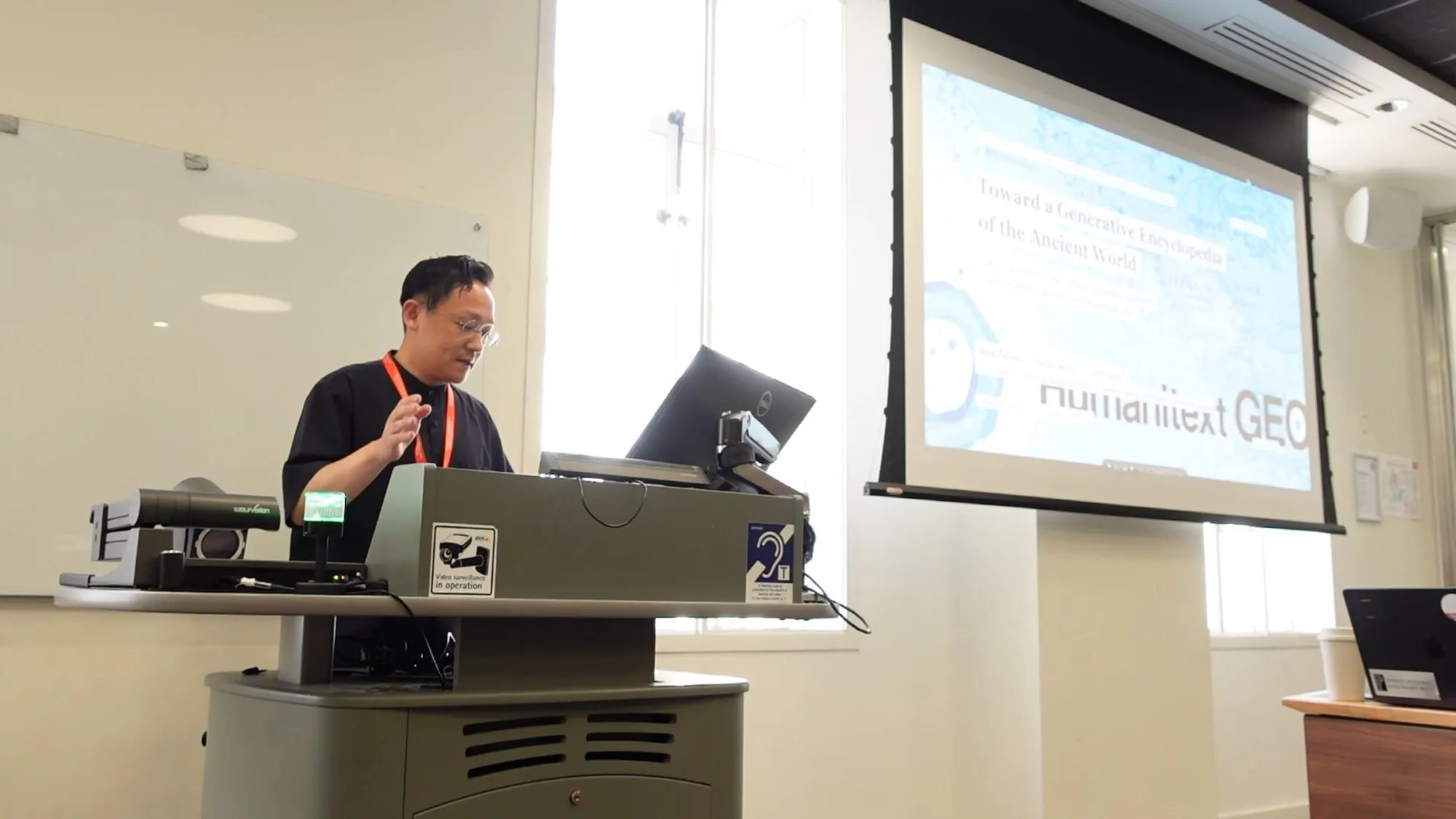
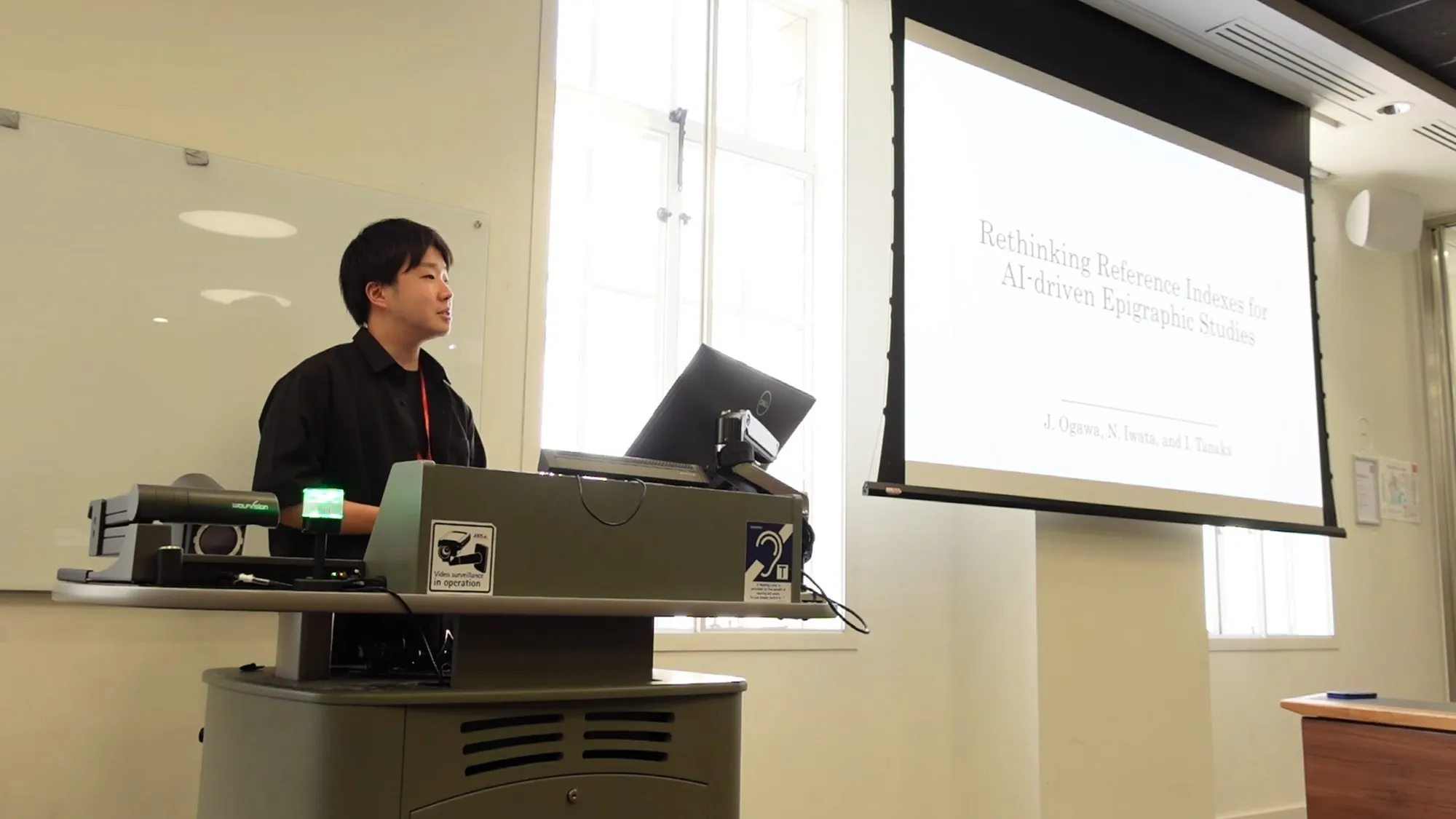
Jun Ogawa, “Rethinking Reference Indexes for AI-driven Epigraphic Studies” [Video]
Using inscriptions as a case study, Ogawa reconsidered how reference indexes should be designed for AI-driven scholarship.
The three talks were followed by an open discussion with the audience on what human–AI collaboration in the humanities should look like. All three talks are available on YouTube.