

Marsyas: The Satyr Who Challenged Apollo and Was Flayed
Marsyas picked up the flute Athena had thrown away, grew confident enough to challenge Apollo to a musical contest, and lost. His punishment — being flayed alive — is among the most brutal in Greek myth. The full story from the ancient sources.

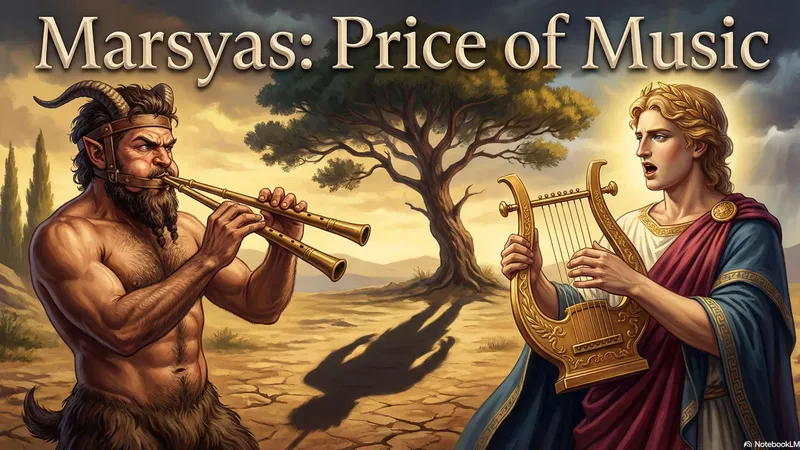
Could beautiful music ever invite such a cruel ending elsewhere? The sound of the flute played by Marsyas, a half-man, half-beast satyr, trembled the souls of those who heard it, but simultaneously awakened the cold wrath of Apollo, the god of art. This is the story of the excessive price paid by one who stepped into the realm of the gods.
The Goddess’s Curse and the Found Flute
The seeds of tragedy were sown long before Marsyas took the flute in hand, by the whim of the goddess Athena. According to the ancient Roman poet Ovid, it was Athena herself who first invented the flute (aulos). She pierced holes in boxwood and created a mechanism to produce sound.
However, the invention brought a humiliating result for the goddess. When Athena blew the flute, her cheeks puffed out greatly, distorting her beautiful face. Upon seeing her reflection in the water, Athena could not bear the ugliness.
prima, terebrato per rara foramina buxo ut daret, effeci, tibia longa sonos, vox placuit: faciem liquidis referentibus undis vidi virgineas intumuisse genas. ars mihi non tanti est; valeas, mea tibia dixi: excipit abiectam caespite ripa suo.
“I was the first to make the long flute produce sounds from boxwood pierced with rare holes. The voice pleased me; but when the clear waters reflected my face, I saw that my virgin cheeks were swollen. ‘My art is not worth this much [sacrifice of beauty]; farewell, my flute,’ I said. The riverbank received the discarded flute on its turf.”
(Ovid Fasti 6.697–702)
It was the Phrygian satyr Marsyas who picked up this flute, which Athena had thrown away because it “made her face ugly” (Apollodorus Library 1.4.2).
Interestingly, Marsyas devised a way to overcome the instrument’s flaw—the distortion of the face during performance. He used a mouth-band made of leather straps and metal clasps called a “phorbeia” to suppress the puffing of his cheeks and hide the facial distortion while playing (Plutarch On the Control of Anger 6). Furthermore, Marsyas is sometimes depicted not merely as a crude beast-man, but as an intellectual being who possessed prudence and maintained chastity (Diodorus Siculus Historical Library 3.58.3). He breathed new life into the instrument discarded by Athena, and its tone earned a reputation in the blink of an eye.
The Arrogant Challenge and Apollo’s Cunning
Deepening his confidence in his own skill, Marsyas eventually committed an irreversible error. He dared to challenge Apollo, the god of music, to a contest to decide who was the superior performer. This was not merely a contest, but an arrogant challenge to divine authority.
The two agreed on a harsh condition: the winner could “treat the loser however he pleased” (Apollodorus Library 1.4.2). The people of Nysa were chosen as judges; Apollo took up the lyre (kithara), and Marsyas took up the flute (Diodorus Siculus Historical Library 3.59.2).
In the first performance, Marsyas’s flute captivated the audience. Its wild and sorrowful tone shook the listeners’ hearts deeply. However, placed in a difficult position, Apollo counterattacked with a cunning and logic unique to a god. Apollo began to sing along with his lyre (Diodorus Siculus Historical Library 3.59.2–3). Or, in another tradition, he played the lyre upside down and demanded Marsyas do the same (Apollodorus Library 1.4.2).
Marsyas protested, “We should be competing in the skill of the instrument; using the voice is unfair.” But Apollo’s rebuttal was cold and logical.
τὸν δὲ Ἀπόλλω μυθολογοῦσιν εἰπεῖν ὡς οὐδὲν αὐτὸν πλεονεκτοίη· καὶ γὰρ τὸν Μαρσύαν τὸ παραπλήσιον αὐτῷ ποιεῖν, εἰς τοὺς αὐλοὺς ἐμφυσῶντα· δεῖν οὖν ἢ τὴν ἐξουσίαν ταύτην ἴσην ἀμφοτέροις δίδοσθαι τῆς κράσεως, ἢ μηδέτερον τῷ στόματι διαγωνιζόμενον διὰ μόνων τῶν χειρῶν ἐνδείκνυσθαι τὴν ἰδίαν τέχνην.
“It is said that Apollo replied that he was taking no advantage at all. For Marsyas was doing the same thing as him by blowing into the flutes. Therefore, either both should be given the equal right to this combination [of mouth and instrument], or neither should use their mouth and show their specific skill with their hands alone.”
(Diodorus Siculus Historical Library 3.59.3–4)
The flute cannot produce sound without the use of breath. The judges were persuaded by Apollo’s reasoning, and Apollo’s victory was confirmed. Before the logic of a god, the satyr’s plea was powerless.
The Flayed Skin and Flowing Tears
The result of the contest was decided. The time came to fulfill the contract made beforehand: “The winner may do as he pleases with the loser.” The punishment Apollo chose was more terrifying than death. He hung Marsyas alive from a pine tree and flayed his entire body (Apollodorus Library 1.4.2).
Ovid’s Metamorphoses depicts this execution with a terrifying vividness. Marsyas screamed, “Why do you tear me from myself?”
“Quid me mihi detrahis?” inquit: “a piget a non est” clamabat “tibia tanti.” Clamanti cutis est summos direpta per artus, nec quicquam nisi vulnus erat; cruor undique manat, detectique patent nervi, trepidaeque sine ulla pelle micant venae; salientia viscera posses et perlucentes numerare in pectore fibras.
“‘Why do you tear me from myself?’ he said. ‘Ah, it hurts! Ah, for a mere flute, is this not too great a price?’ he cried. As he screamed, his skin was stripped from the surface of his limbs. He was nothing but a wound; blood flowed from everywhere. Muscles were exposed, and veins pulsed without any skin. You could count the throbbing viscera and the translucent fibers in his chest.”
(Ovid Metamorphoses 6.385–391)
At this gruesome sight, the forest spirits, satyrs, nymphs, and shepherds shed tears. Their tears soaked into the earth and eventually became a river. It is said that this is the origin of the Marsyas River, the clearest river flowing through Phrygia (Ovid Metamorphoses 6.396–400; Palaiphatos De Incredibilibus 47).
It is said that even the victorious Apollo felt remorse for the cruelty of his own actions. He temporarily cut the strings of his lyre and distanced himself from music (Diodorus Siculus Historical Library 3.59.5).
The story of Marsyas serves as a lesson on how reckless it is to challenge a god, but simultaneously, it conveys to the modern age a vivid image that art sometimes entails pain and sacrifice enough to tear apart living flesh. The sound of that flute—discarded by Athena, picked up by Marsyas, and judged by Apollo—may still be echoing in the murmuring of the river today.
(Editing assistance: Yuki Suzuki)
More on Myths of Metamorphosis

Baucis and Philemon: The Couple Who Hosted the Gods
Only one poor elderly couple opened their door to Jupiter and Mercury travelling in disguise. Their reward was to be turned, at the moment of death, into two trees standing side by side so that neither would outlive the other. From Ovid's Metamorphoses.

Narcissus and Echo: Ovid's Tale of Vanity and Lost Love
Echo, cursed to repeat only the words of others, fell in love with Narcissus and was rejected until nothing but her voice remained. Narcissus, in turn, fell in love with his own reflection and wasted away beside it. From Ovid's original Latin.

Pygmalion and Galatea: The Statue That Came to Life
Pygmalion fell in love with the ivory statue he had carved, and Venus granted his wish by giving it life. Reading Ovid's original text, this article also explains why the woman was never actually called 'Galatea' in antiquity.

Arion and the Dolphin: The Musician Saved by the Sea
Arion, the greatest musician of ancient Greece, was robbed by sailors and forced overboard. A dolphin, drawn by the song he sang before leaping, carried him safely to shore. The story as told by Herodotus and Ovid.