

Why Ancient Greeks Hated Philosophers: The Harshest Insults
Socrates was mocked as a poor chatterbox, and philosophers were dismissed as useless in real life. These ancient Greek and Roman insults reveal the irritation and unease that professional thinkers provoked.


“I hate that poor chatterbox Socrates.”
This is not a nasty post from modern social media. It is an insult directed at a philosopher, preserved in ancient Greek comedy.
Today, ancient philosophers are often revered almost like saints. Yet in the streets of their own time, they were also dismissed as eccentrics, useless people, and tiresome scolds, and they were subjected to remarkably merciless language.
1. Impressive in Theory, Useless in Real Life
The criticism philosophers received most often was that they were impressive in theory but useless in real life.
One famous example is the story of Thales falling into a well while gazing at the stars.
It is said that when Thales, while looking up to observe the stars, fell into a well, a witty Thracian slave-girl mocked him by saying that he was so eager to know what was in the heavens that he failed to notice what was before his eyes and at his feet. This mockery applies to everyone who spends his life in philosophy.
(Plato, Theaetetus 174a-d)
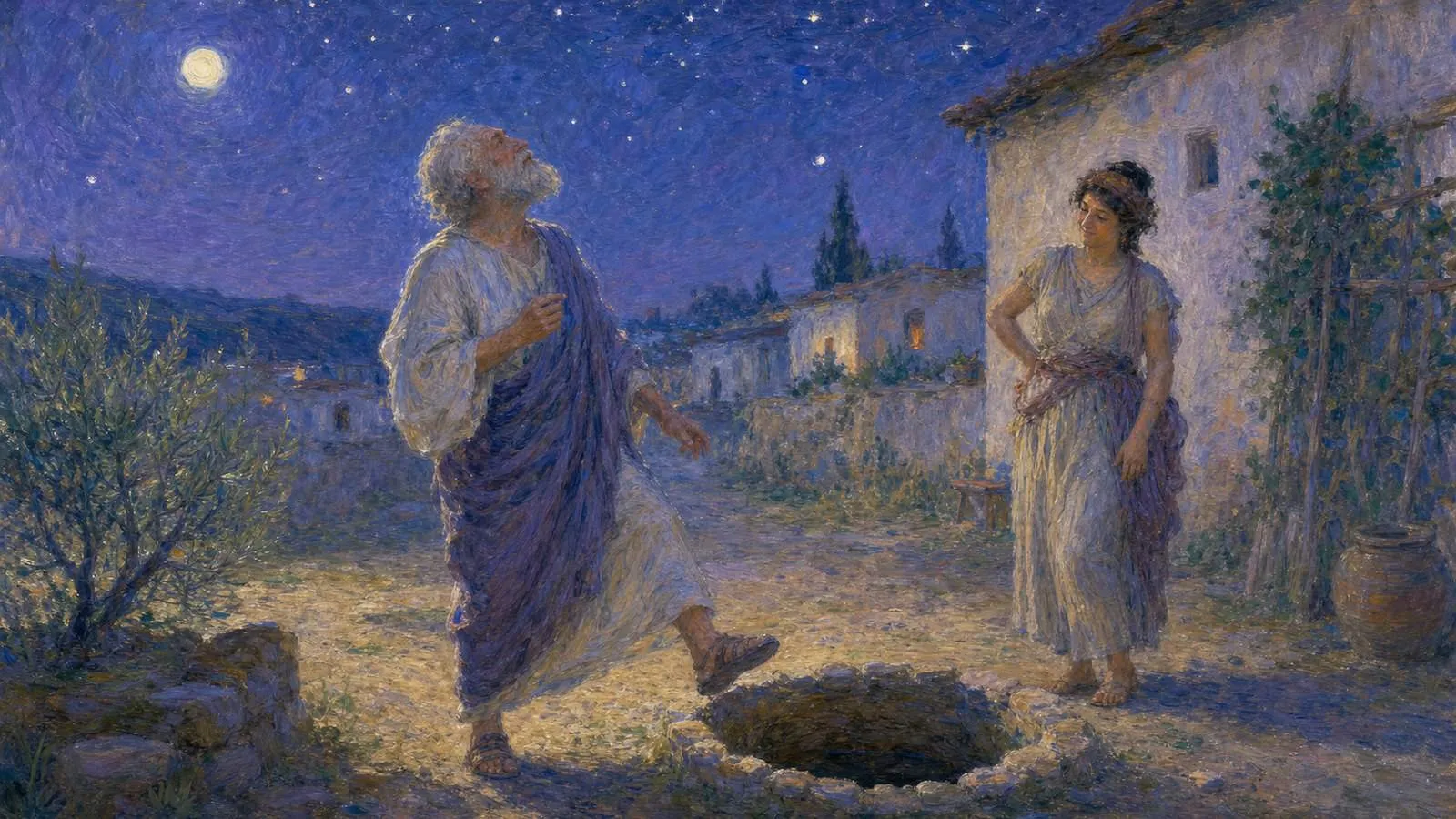
It sounds like a joke, but Thales himself is not the only target here. Through this anecdote, Plato shows that philosophers as a group could be seen by the public as people who failed to notice even what was right in front of them.
The story of Thales can be told as a comic anecdote, but the same kind of criticism also survives in a sharper form. According to the physician Galen, philosophers were people who could speak confidently about what lay “outside the world,” yet proved helpless when faced with concrete tasks.
You self-proclaimed wise teachers are always like this. You think you know what lies outside this world, though such things can only be guessed at and cannot be scientifically demonstrated. And yet, when it comes to a practical matter that anyone nearby would know, such as how to compare the weight of water and wood, you are completely at a loss.
(Galen, On the Diagnosis and Cure of the Soul's Errors, p. 100)
In modern terms, this resembles the frustration people feel toward someone who can discuss grand theories but knows nothing about the realities on the ground. To some people in antiquity, philosophers looked like ridiculous braggarts who claimed to understand the truth of the cosmos while being unable to manage ordinary life.
2. Speaking of Truth, but Lacking a Livelihood
“If you have time to talk about ideals, worry first about what you will eat tomorrow.” This is a kind of criticism we still hear today. People who speak about lofty principles are often met with the question: “But are you actually able to support yourself?” Antiquity had the same kind of retort.
In a line by a comic poet quoted by Asclepius of Tralles (note 1), Socrates is portrayed precisely in this way.
I hate that poor chatterbox Socrates. He has thought deeply about other matters, but as for how to get his livelihood, he has not given it the slightest thought.
(Asclepius of Tralles, Commentary on Aristotle's Metaphysics (Books Alpha-Zeta) 135.23-24)
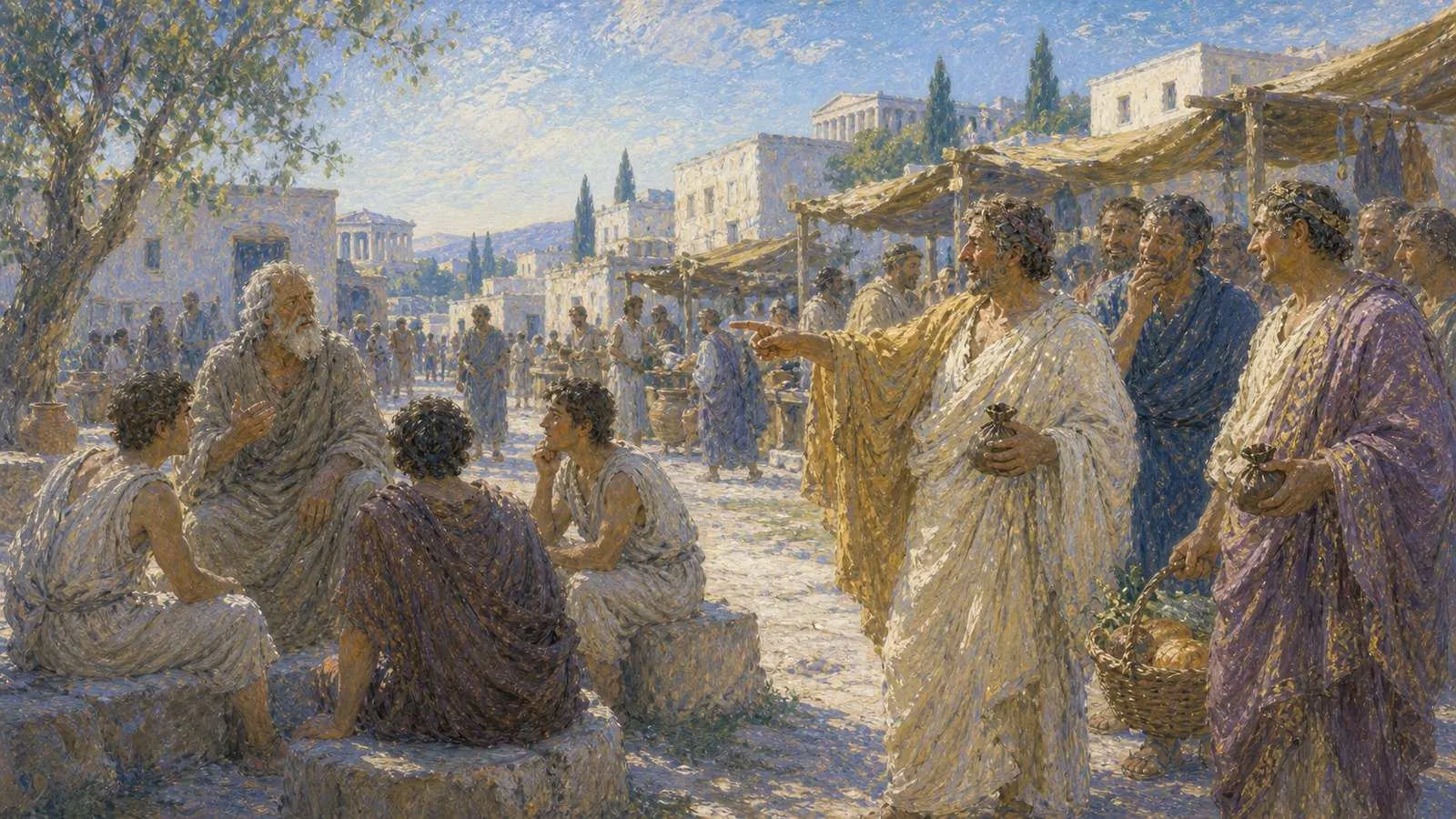
What is being ridiculed here is not simply Socrates’ poverty. Rather, it is the mismatch between thinking about profound questions of the world and failing to make one’s own life work. The philosopher was a seeker of truth, but to those around him he could also look like someone whose thoughts were admirable and whose daily existence was unreliable.
In the same passage, philosophers’ tendency to engage in tiny, hair-splitting arguments is compared to the pettiness of a miser. Their arguments are described as base narrowness and clever little scraps of reasoning.
3. High-Minded Pretenders
Philosophers were mocked for being poor. But if they sought stability by approaching powerful patrons, did that win them respect? Not necessarily.
Then they were suspected of the opposite: “You say noble things, but in the end perhaps you love money, pleasure, and power after all.” Even today, people who preach morality or ideals are sometimes met with the objection that they themselves are not especially pure. Ancient philosophers were viewed in much the same way.
He will sniff around our school and accuse philosophers by saying that they receive subsidies, indulge in women, and give themselves over to fine dining. He will point out that one philosopher is in the middle of an affair, another is constantly at the tavern, and another is currying favor at court.
(Seneca, Letters to Lucilius 29.5)
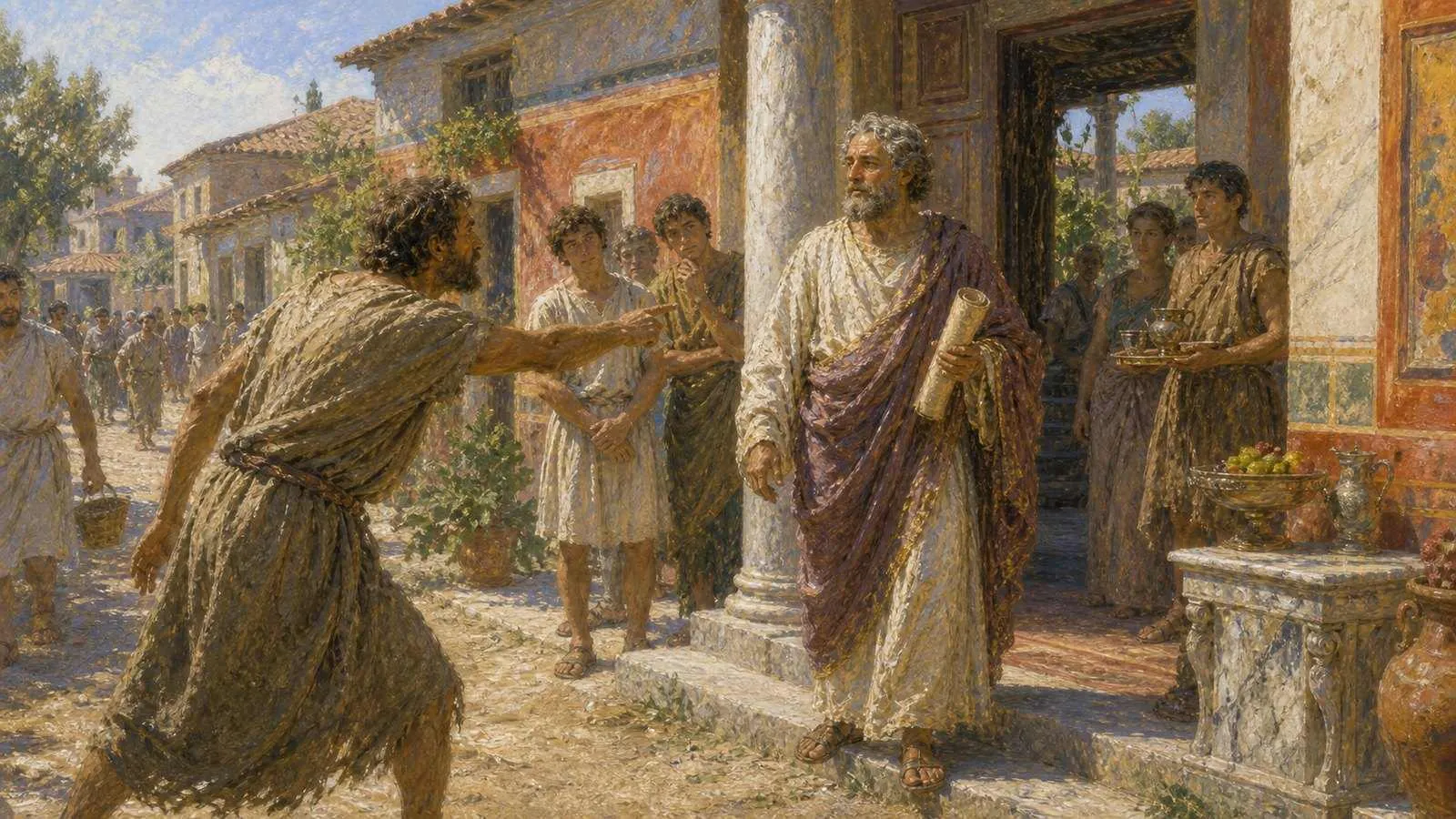
In other words, if philosophers were poor, they were laughed at as poor pedants. If they received support, they were suspected of using philosophy as a way to profit. Whichever way they turned, public opinion could be harsh.
Seneca, however, did not regard such criticism as a just accusation. For him, the problem was not that philosophers were not flawless. The problem was that critics used their imperfections as an excuse to claim that trying to live nobly was meaningless in the first place.
From Seneca’s perspective, philosophers were at least people trying to walk toward virtue. Even if their footing was unsteady, the direction in which they were moving was upward. Their critics, however, ignored their own vices and looked for small faults in those who aimed higher, dragging them down by saying, “Look, they are nothing special either.” Seneca replies with biting irony:
You observe another person’s small pimple while you yourselves are covered with countless ulcers. It is as though, while your own body is being eaten away by a terrible mange, you point at a mole or wart on the most beautiful body and laugh.
(Seneca, On the Happy Life 27.4)
This is a fierce comeback. What Seneca saw was not merely “insults against philosophers.” By hunting for faults in those trying to live well, critics justified their own refusal to try. That dishonesty was, for Seneca, the real issue.
4. They Judge Us with Their Righteousness
Poverty and suspicion about money were not the only reasons philosophers were disliked. More fundamentally, philosophers seem to have been perceived as people who would judge others.
No one enjoys feeling that their way of life is about to be corrected without being asked. Precisely because the criticism may be right, people often want to label the critic in advance as arrogant or troublesome. Dio Chrysostom describes this reaction with remarkable sharpness.
People suspect that philosophers despise them and think them ignorant and miserable. They imagine: ‘He does not laugh at us to our faces, but surely he thinks that we, being uneducated, are wretched people.’ So they strike first, abusing and mocking philosophers as miserable fools. And when they see someone dressed like a philosopher, they think: ‘This man is not dressed this way for sailing, farming, or tending sheep. Rather, he has armed himself against human beings, intending to admonish and refute them, never flattering anyone, sparing no one, and even using words to punish us as much as possible and expose what kind of people we are.’
(Dio Chrysostom, Orations 72.7-10)

What is disliked here is not simply the philosopher’s clothing. A rough cloak, long hair, and a beard were not just outward features. They could be read as a silent sign saying, “I am the kind of person who questions how you live.”
That is why people braced themselves at the mere sight of a philosopher. To them, the philosopher was like a nagging moral instructor who appeared in the street. Before being lectured directly, they struck first by calling him wretched or foolish. Behind this response lay not only contempt, but also fear of being seen through.
Conclusion: Why Were Philosophers Hated?
When we line up these ancient insults, it becomes clear that philosophers were not disliked simply because they were strange.
They looked like theorists whose ideas were useless in real life. They spoke of truth while failing to maintain their own livelihood. They preached virtue while appearing not to be free from money, pleasure, or power. Above all, they seemed to judge other people’s way of life from above.
The insults aimed at philosophers contained not only mockery of intellectuals, but also anxiety: “Perhaps my life is about to be denied.” That is why people laughed at them, abused them, and tried to drag them down.
Even so, more than two thousand years later, the words of the philosophers remain as classics. At the same time, the insults hurled at them also survive with startling vividness.
It would be easy to laugh at these insults as immature reactions by ancient people. But can we really say that similar reactions do not exist today?
We distance ourselves from people who think through complicated matters by calling them troublesome. We dismiss knowledge that is not immediately useful as pointless. We hear painful words as condescension. Such reactions seem to remain with us, though in different forms.
Philosophy is not only the pursuit of lofty truth. It is also something that can enter the middle of everyday life so deeply that it irritates people, makes them laugh, and sometimes makes them angry.
Aside: What Did Philosophers Look Like?
As we have seen, ancient people reacted strongly not only to philosophers’ words, but also to their appearance. What, then, did a “philosopher-like” appearance look like? As an aside, let us look a little more closely at the outward image of ancient philosophers.
In the Greek and Roman world, philosophers could be recognized at a glance. A rough cloak, a long beard, and long hair were typical markers. Cynic philosophers in particular might carry a staff and a pouch, and sometimes went barefoot (Dio Chrysostom, Orations 72.2; Tatian, Address to the Greeks 25; Pseudo-Lucian, The Cynic 17).
The most representative item was the tribon, a rough cloak. Philosophers might wear this cloak directly on the skin without the chiton, the undergarment. This was not merely an expression of poverty. It was a style that signaled avoidance of luxury, endurance of heat and cold, and self-discipline (Dio Chrysostom, Orations 72.2; Pseudo-Lucian, The Cynic 17).
Beards and long hair also carried meaning. A beard was associated with wisdom and masculinity, and it could evoke the image of gods such as Zeus and Poseidon. Not over-grooming one’s hair or beard also expressed a refusal to be ruled by fashion or conventional values (Dio Chrysostom, Orations 72.5; Pseudo-Lucian, The Cynic 20; Tatian, Address to the Greeks 25).
Not every philosopher looked the same, however. Cynics were especially austere and conspicuous, while some Stoics maintained a neater and cleaner appearance. Even “philosopher-like” appearance varied by school (Pseudo-Lucian, The Cynic 17; Lucian, Hermotimus, or On the Philosophical Schools 18).
The problem was that this appearance became an extremely legible sign. Put on a cloak and grow a beard, and one could immediately look like a philosopher. That is why “philosophers in appearance only” also appeared. There is a story that when a man with a long beard and cloak came asking for money, Herodes Atticus replied: “I see the beard and the cloak, but I do not yet see the philosopher” (Aulus Gellius, Attic Nights 9.2.1-4).
In short, the philosopher’s appearance functioned like a signboard for the state of the soul. It visibly displayed a posture of distancing oneself from luxury, refusing to be bound by conventional values, and trying to live freely. Yet the more conspicuous the signboard became, the more people wondered whether there was any substance behind it. Ancient philosophers attracted respect through their clothing and beards, but they also attracted ridicule and mistrust (Dio Chrysostom, Orations 72.1-6; Aulus Gellius, Attic Nights 9.2.9-11).
Note
- Eupolis, in T. Kock (ed.), Comicorum Atticorum fragmenta, vol. 1, Leipzig: Teubner, 1880, fr. 352.1.
More on Ancient Philosophy and the Art of Living

Otium: Pliny the Younger on Roman Villas and Leisure
Otium was not idleness but the leisure the Romans prized as time for thought and creation. Through Pliny the Younger's letters describing life at his villas, this article explores what that ideal actually meant.

Ancient Wisdom on Work and Preparation - Lessons from Hesiod, Xenophon, and Cicero
From the Greek poet Hesiod to the Roman philosopher Cicero, ancient sages taught the importance of work and preparation. This article explores their wisdom on overcoming procrastination and enriching life through diligence and order.

The Ancient Philosophy of Loss and Affection - Seneca and Plutarch on Parental Fortitude and Unconditional Love
The Stoic Seneca teaches the stern acceptance of losing a child, while Plutarch argues that the purpose of raising children is affection. This article explores the universal wisdom left by ancient sages on parental love and the tragedies of life.

Ancient Wisdom - A Collection of Aphorisms on Learning and Culture
From the Delphic maxims to Plutarch's essence of learning. We explore the core of the culture needed to "live well," as left behind by the sages of ancient Greece and Rome.