

Dreaming of Lightning: What the Ancient Greeks Believed It Meant
Being struck by lightning in a dream was not an omen of disaster. Artemidorus, antiquity's greatest dream interpreter, read it as a promise that a poor man's life would be overturned for the better. Here is what the original text actually says.

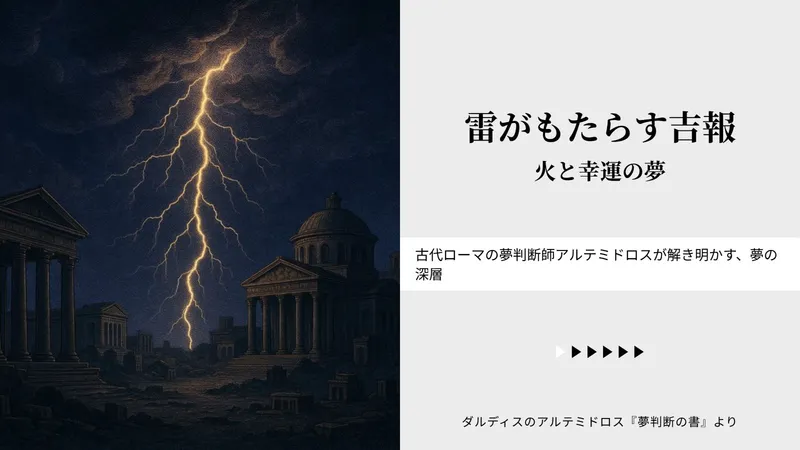
A Terrifying Vision, A Surprising Fortune
How could a dream of being struck by a divine thunderbolt—a vision of terrifying, instantaneous destruction—be anything but a terrible omen? In the ancient world, where dreams were seen as messages from the gods, one might assume such a nightmare foretold only disaster. Yet, for the great dream interpreter Artemidorus, the truth was far more complex and, for some, surprisingly optimistic. He classified certain dreams as unsettling in their appearance but ultimately positive in their outcome, and the dream of being struck by lightning was a prime example.
For a poor person, this violent vision was not a curse but a promise of radical transformation. Artemidorus placed this dream in a special category where the initial horror of the vision belied a fortunate result. He noted that while the experience of the dream itself might be frightening, the final interpretation was one of hope. This was not a simple superstition but part of a sophisticated system of analysis where the dreamer’s own life circumstances were the essential key to unlocking the message.
Artemidorus explains that some dreams are deceptive, appearing one way but signifying another. For a person of little means, the lightning strike was the ultimate paradox: a vision of death that promised a new, more prosperous life.
κεραυνοῦσθαι δοκεῖν πένητα ὄντα… ἀγαθόν…
“for a poor man to dream of being struck by lightning… is good…”
(Artemidorus *Onirocriticon*, p. 15)
He clarifies this principle by stating that for this class of dreams, the surface-level experience is completely inverted in its real-world meaning. The fear felt in the dream would turn to joy upon waking and understanding its true significance.
καὶ εἰσὶν αὐτῶν αἱ μὲν ὄψεις κακαί, αἱ δὲ ἀποβάσεις ἀγαθαί.
“and their appearances are bad, but their outcomes are good.”
(Artemidorus *Onirocriticon*, p. 15)
The Logic of Divine Fire
Why would such a violent act from the heavens bring wealth? The ancient interpreters, whom Artemidorus cites, developed powerful analogies to explain this seeming contradiction. They argued that the dream was a message of profound reversal, a principle they saw mirrored in the real-world effects of a lightning strike. The core of their argument was that for the poor, this dream was good, but for the wealthy, it was a catastrophe.
πένησι μὲν ἀγαθὸν εἶναι πλουσίοις δὲ κακὸν…
“good for the poor, but bad for the rich…”
(Artemidorus *Onirocriticon*, p. 110)
The first line of reasoning was an analogy of place. The poor, in their humble state, were compared to unremarkable, plain plots of land. The rich, with their status and possessions, were like magnificent temples or sacred groves. When lightning strikes an insignificant place, it consecrates it; altars are built there, and it becomes a site of worship—it is made significant. But when lightning strikes a grand temple, it renders it desolate and forbidden.
ὥσπερ οὖν ὁ κεραυνὸς τὰ μὲν ἄσημα τῶν χωρίων ἐπίσημα ποιεῖ… τὰ δὲ πολυτελῆ χωρία ἔρημα καὶ ἄβατα ποιεῖ… οὕτως ὁ ὄνειρος πένητα μὲν ὠφελεῖ, πλούσιον δὲ βλάπτει.
“Just as the thunderbolt makes insignificant places significant… but makes magnificent places desolate and inaccessible… so the dream helps a poor man but harms a rich one.”
(Artemidorus *Onirocriticon*, p. 110-111)
A second, more direct logic was that lightning is fundamentally fire, and the nature of fire is to destroy matter. The “matter” that defines a poor person is their poverty; for a wealthy person, it is their riches. Therefore, the divine fire of the dream would burn away the dreamer’s essential material state. For the poor man, his poverty is destroyed, while for the rich man, his wealth is annihilated.
τοιγαροῦν τοῦ μὲν τὴν πενίαν τοῦ δὲ τὸν πλοῦτον φθερεῖ…
“Therefore, it will destroy the poverty of the one, and the wealth of the other…”
(Artemidorus *Onirocriticon*, p. 111)
Finally, the dream signified a sudden and dramatic shift in public visibility. A person struck by lightning becomes instantly “conspicuous” or remarkable. This mirrors the social transformation that occurs when a poor person suddenly acquires great wealth or a rich person loses everything. They become objects of public notice, their status forever changed by a singular, dramatic event.
Beyond Wealth: The Thunderbolt’s Broader Impact
The thunderbolt’s dream-message was not just about money. It was a symbol of such radical change that it could reshape every aspect of a person’s life, from their social status to their family relationships. For a slave, the dream was a powerful omen of liberation. Just as those struck by lightning in the real world were considered sacred to Zeus and no longer served a human master, a slave who had this dream could expect freedom.
δούλων μὲν τοὺς μὴ ἐν πίστει ὄντας ἐλευθεροῖ…
“It frees those slaves who are not in a position of trust…”
(Artemidorus *Onirocriticon*, p. 111)
For the unmarried, the dream’s fiery nature pointed toward a different kind of heat: the passion of love and marriage. Artemidorus explains this with a frank comparison, stating that the dream foretells a union because “for nothing heats the body so much as fire and a woman.” However, what the thunderbolt gives to the single, it takes from the attached. For those already married or in close partnerships, the dream was a terrible sign. Its nature is to divide, not to unite.
ἀγάμοις δὲ γάμον προαγορεύει… γεγαμηκότας δὲ διίστησι καὶ κοινωνοὺς καὶ ἀδελφοὺς καὶ φίλους ἐχθροὺς ποιεῖ· οὐδὲν γὰρ ὁ κεραυνὸς ἑνοῖ, ἀλλὰ καὶ τὰ ἡνωμένα χωρίζει.
“For the unmarried, it foretells marriage… but it separates the married and makes partners, brothers, and friends into enemies. For the thunderbolt unites nothing, but on the contrary, it separates even things that are united.”
(Artemidorus *Onirocriticon*, p. 112)
This theme of separation extended even to one’s children. Artemidorus draws an analogy to a tree struck by lightning, which withers and loses its shoots. Since a person’s offspring are their “shoots,” the dream foretold the loss of one’s children. The dream also had legal implications. For a person on trial for their civic rights, being struck by lightning was a good omen, because a person consecrated by a thunderbolt could never be considered dishonored. In fact, they were honored as if by a god.
Context is Everything: When and How You Are Struck
In the intricate world of ancient dream interpretation, details were never trivial. The meaning of a lightning dream could shift dramatically based on the specific circumstances of the vision. It mattered greatly whether the lightning actually touched the dreamer’s body. A near miss was a message of displacement, not transformation.
Κεραυνὸς δὲ ἄνευ χεπιμῶνος πλησίον πεαὼν καὶ μὴ ἁψάμενος τοῦ σώματος ἐκβάλλει τῶν τόπων τὸν ἰδόντα…
“A thunderbolt that falls nearby in the absence of a storm and does not touch the dreamer’s body, expels the dreamer from the place where he is…”
(Artemidorus *Onirocriticon*, p. 110)
If the dreamer was directly hit, the location of the strike was critical. A bolt to the head or chest was profoundly significant, implying a total life change. However, if the lightning only singed another part of the body, the effects would be proportionally smaller. As Artemidorus notes, when the whole body is not consumed, “then the outcomes become smaller.” The dreamer’s posture was also key: it was a good sign to be struck while standing upright or sitting on a throne, but a bad sign if one was lying in bed or on the ground.
The power of this symbolism was so strong that it extended to related visions. Artemidorus states that another terrifying dream—being burned alive—carried the exact same set of meanings. This parallel reinforces the core interpretation: a vision of fiery destruction was, for the poor and the enslaved, a promise of salvation and a new beginning.
Ζῶντα κατακαίεσθαι τὰ αὐτὰ τῷ κεραυνοῦσθαι σημαίνει.
“To be burned alive signifies the same things as being struck by lightning.”
(Artemidorus *Onirocriticon*, p. 183)
Overall Summary
This narrative explores the ancient interpretation of dreaming of being struck by lightning, as detailed by Artemidorus in his Onirocriticon. Contrary to modern intuition, this terrifying vision was considered a powerfully positive omen for the poor and enslaved. The dream signified a radical reversal of fortune, promising wealth to the poor and freedom to the enslaved. This interpretation was justified through a series of analogies: just as lightning consecrates a humble place, the dream elevates a humble person; and just as fire destroys matter, the dream-fire destroys the “matter” of poverty. The dream’s meaning also extended to social relationships, foretelling marriage for the single but separation for the married. The specific details of the dream—such as where the lightning struck and the dreamer’s posture—were crucial for a precise interpretation, demonstrating the complexity of ancient oneiromancy.
References by Section
A Terrifying Vision, A Surprising Fortune
- Artemidorus, Onirocriticon, p. 15
The Logic of Divine Fire
- Artemidorus, Onirocriticon, p. 110
- Artemidorus, Onirocriticon, p. 110-111
- Artemidorus, Onirocriticon, p. 111
Beyond Wealth: The Thunderbolt’s Broader Impact
- Artemidorus, Onirocriticon, p. 111
- Artemidorus, Onirocriticon, p. 112
Context is Everything: When and How You Are Struck
- Artemidorus, Onirocriticon, p. 110
- Artemidorus, Onirocriticon, p. 113
- Artemidorus, Onirocriticon, p. 183
(Editorial Assistance: Chieka Saito、Nene Nishikawa)
More on Dream Interpretation in Antiquity
Artemidorus: How the Ancient Greeks Interpreted Dreams
Antiquity's greatest dream interpreter held that the same dream meant different things depending on the dreamer's status, trade, and circumstances. An introduction to this systematic ancient method, drawn from the Oneirocritica itself.
Why Ancient Greeks Hated Philosophers: The Harshest Insults
Socrates was mocked as a poor chatterbox, and philosophers were dismissed as useless in real life. These ancient Greek and Roman insults reveal the irritation and unease that professional thinkers provoked.
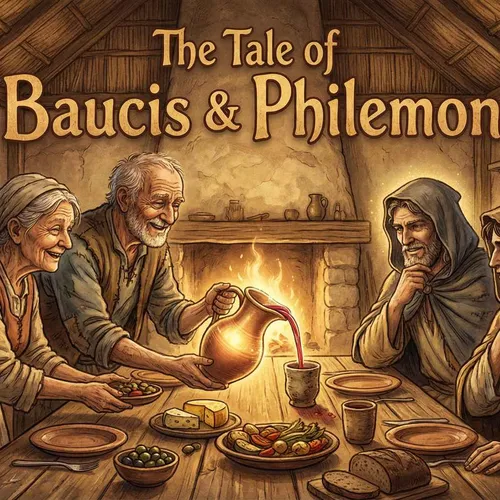
Baucis and Philemon: The Couple Who Hosted the Gods
Only one poor elderly couple opened their door to Jupiter and Mercury travelling in disguise. Their reward was to be turned, at the moment of death, into two trees standing side by side so that neither would outlive the other. From Ovid's Metamorphoses.

Narcissus and Echo: Ovid's Tale of Vanity and Lost Love
Echo, cursed to repeat only the words of others, fell in love with Narcissus and was rejected until nothing but her voice remained. Narcissus, in turn, fell in love with his own reflection and wasted away beside it. From Ovid's original Latin.